Tuscan Honey Guide
Tuscan Honey Varieties: Acacia, Chestnut & More
Compare Tuscan acacia, chestnut, wildflower and honeydew honey by taste, colour, crystallisation and best uses—plus what labels reveal about origin.
Quick answer
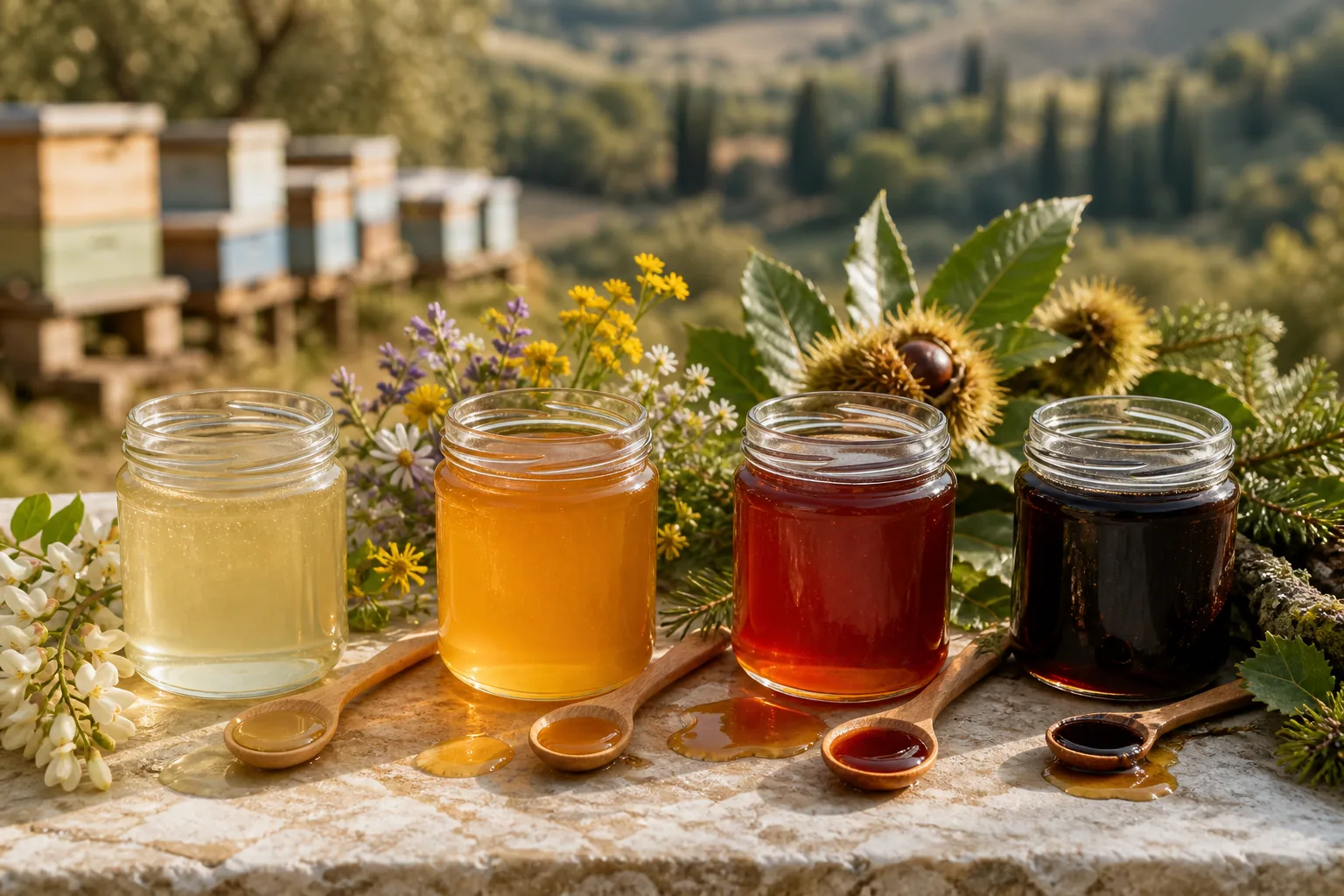
Tuscan honey is not one fixed flavour. Its colour, aroma, sweetness and tendency to crystallise depend heavily on the nectar or honeydew available to bees, the timing of the harvest and local conditions. Names such as acacia, chestnut and wildflower describe botanical origin, not a guaranteed tasting profile. Check the label for origin and producer information, then treat sensory descriptions as useful guidance rather than proof.
| Criterion | Typical character | Useful context |
|---|---|---|
| Acacia | Pale, delicate and usually slow to crystallise. | Good for tea, yoghurt and mild cheeses. |
| Chestnut | Dark, assertive and sometimes gently bitter. | Good with aged cheese and savoury dishes. |
| Wildflower | Seasonal, layered and naturally variable. | A versatile expression of mixed local forage. |
| Honeydew | Often dark, less floral and malt-like. | Produced from honeydew rather than floral nectar. |
Why Tuscan honey is not one flavour
Tuscany contains coastal areas, hills, woodland and cultivated landscapes. A hive's forage changes with location, weather and flowering. Honey gathered during one part of the season can therefore differ markedly from honey gathered later, even when both jars come from the same region.
A geographical description answers where the honey comes from. A botanical description addresses the nectar or honeydew that predominates. Neither should be inferred from colour alone. Reliable identification combines traceable production information with appropriate analysis when a formal monofloral claim is made.
Acacia honey: light, delicate and slow to crystallise
Honey sold as acacia in Italy is associated with black locust, Robinia pseudoacacia. It is commonly pale, gently aromatic and relatively mild. Its sugar profile often allows it to remain liquid longer than many other honeys, but storage temperature and the individual batch still matter.
The flowering window can be brief and weather-sensitive. Rain or cold during bloom may limit bee flight and nectar availability. That is why a local beekeeper cannot responsibly promise the same quantity or sensory result every year.
Chestnut honey: darker and more assertive
Chestnut honey is often darker, less conventionally sweet and more persistent than delicate floral honeys. People may describe woody, tannic or gently bitter notes, but tasting language is subjective and varies by batch.
Its distinct character makes it useful in savoury pairings as well as on bread or cheese. The important distinction is that a strong taste is not evidence of superior purity. It is primarily a different botanical and sensory expression.
Wildflower honey reflects a mixed landscape
Wildflower, or millefiori, honey is produced from a mixture of floral sources rather than one predominant blossom. That makes variation part of its identity. A spring jar may be lighter and more floral; a later harvest may be deeper or more herbaceous.
The term should not be read as a precise recipe. It describes plurality. For a buyer who wants a sense of season and place, that variability can be a strength—provided the producer is clear about origin and harvest context.
Honeydew honey begins beyond the flower
Not every honey begins with floral nectar. Honeydew honey comes from sweet substances found on living plant parts and collected by bees. It is often darker and less floral in character, though no visual shortcut can confirm its identity.
EU rules define honey broadly enough to distinguish nectar honey from honeydew honey. The label and producer's traceability remain more dependable than internet tests based on thickness, flame or water.
How to choose a Tuscan honey
Choose acacia when you want a delicate, generally slower-crystallising honey; chestnut when you prefer an assertive profile; wildflower when seasonal variety appeals; and honeydew when you want a darker, non-floral style. These are useful tendencies, not guarantees.
Before buying, read the legal name, country of origin and producer or packer details. Ask whether the botanical description belongs to that batch. If a brand tells an apiary story, look for a real location and wording that separates verified observations from general beekeeping knowledge.
- ●Read the country-of-origin statement.
- ●Identify the producer or responsible food business.
- ●Treat botanical names as batch-specific claims.
- ●Expect natural variation between seasons.
- ●Reject home tests presented as proof of authenticity.
Sources and further reading
Primary and institutional references used to review the factual claims in this guide. Product details and prices are BeePatron information.
Frequently asked questions
What is the best-known type of Tuscan honey?
There is no single best Tuscan honey. Acacia, chestnut, wildflower and honeydew styles serve different tastes, and availability varies by place and season.
Does dark honey mean it is more authentic?
No. Colour is influenced by botanical origin and other factors. It cannot establish geographical origin or detect adulteration by itself.
Is wildflower honey lower quality than monofloral honey?
No. Wildflower describes a mixed floral origin. Quality depends on production, composition, handling and traceability—not on whether one flower predominates.
Can every Tuscan harvest produce the same honey?
No. Flowering, weather, forage and beekeeper decisions vary, so flavour, colour, texture and volume can change between harvests.
Follow a Real Tuscan Apiary Story
Explore named hives at Le Gusciane and choose a plan built around place, season and transparent expectations.
Compare adoption plans