
Honey Science
Why Honey Crystallizes—and What It Does Not Tell You
Crystallisation is a normal physical change in many honeys. Learn why it happens, how to soften honey gently and which popular purity tests to ignore.
Quick answer
Honey crystallises when dissolved sugars—especially glucose—form crystals. Botanical origin, the glucose-to-water balance, temperature and small particles such as pollen can influence the rate. Crystallisation alone does not prove that honey is raw, local, pure or fake. It is usually a texture change rather than spoilage.
Crystallisation is a normal process
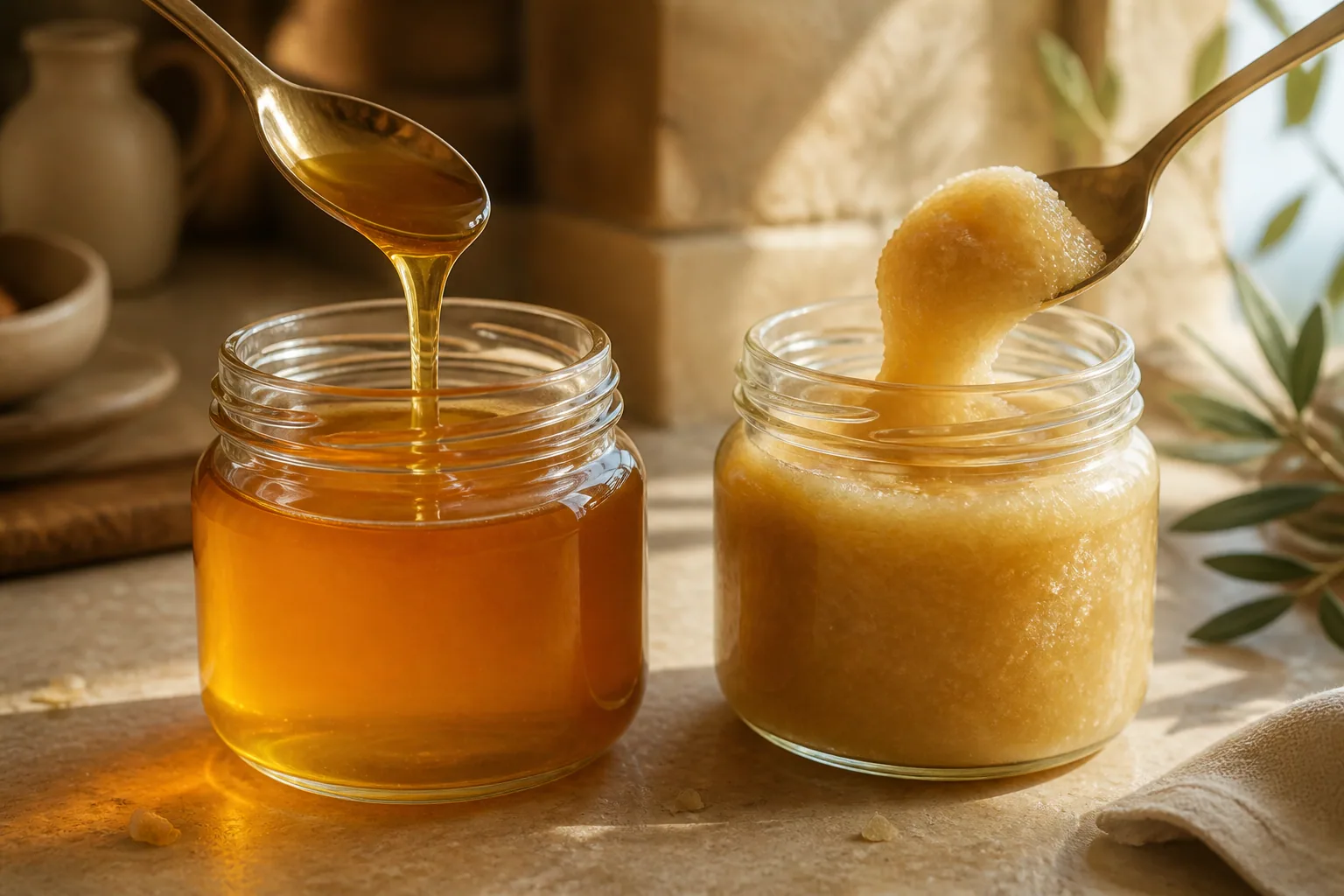
Honey is a concentrated sugar solution. Over time, glucose can leave that solution and arrange into crystals, while the remaining liquid contains a higher proportion of water and fructose. The result may be fine and creamy or coarse and grainy.
Some honeys change quickly; others remain liquid for much longer. That difference does not create a simple quality ranking. A pale liquid honey and a fully set honey can both meet the same legal definition and composition requirements.
What controls how quickly honey sets
Botanical origin affects the balance of sugars in honey. Batches with proportionally more glucose tend to crystallise more readily, while honeys with more fructose may remain liquid longer. Moisture, storage conditions and microscopic seed crystals also influence the process.
Temperature matters, but a household jar does not behave like a laboratory sample. Moving honey between warm and cool places, repeatedly opening it and introducing crumbs can all affect texture. Those variables make visual comparisons between two jars unreliable as authenticity tests.
- ●Botanical source and sugar balance
- ●Moisture content
- ●Storage temperature and temperature changes
- ●Pollen, wax or existing microscopic crystals
- ●Time since extraction and packing
What crystallisation cannot prove
Claims that 'real honey always crystallises' turn a common tendency into an absolute rule. Different authentic honeys crystallise at different rates. Processing and storage can alter timing, but the appearance of crystals cannot reconstruct the jar's full production history.
The reverse claim is also unsafe: liquid honey is not automatically adulterated. Acacia-type honey may remain fluid for an extended period. Authentication requires traceability and, when necessary, validated analytical methods—not a photograph or kitchen experiment.
How to soften crystallised honey gently
If you prefer liquid honey, place the closed jar in warm—not boiling—water and stir after the crystals begin to loosen. Work gradually and avoid direct high heat. The goal is a pleasant serving texture, not sterilisation.
Only warm the amount you expect to use when practical. Repeated heating and cooling can affect sensory quality. Always follow the storage instructions and best-before information supplied with the product.
When crystallisation is intentional
Creamed or set honey uses controlled crystallisation to create a spreadable texture with small crystals. It is not honey with dairy cream added. Producers manage crystal formation so the texture feels smooth and stable.
This is a useful reminder that crystallisation is not merely a defect to reverse. In skilled handling, it can become a desired sensory form.
Use provenance instead of viral purity tests
Water, flame, thumb and bread tests circulate because they seem immediate. They are not reliable ways to establish origin or detect sophisticated adulteration. Viscosity and moisture vary naturally, and a household test lacks controls.
A better first step is documentary: read the country of origin, identify the responsible producer or packer and look for batch information. EU institutions are working on harmonised analytical methods because honey authentication is a technical problem, not one a kitchen trick can solve.
Sources and further reading
Primary and institutional references used to review the factual claims in this guide. Product details and prices are BeePatron information.
Frequently asked questions
Is crystallised honey safe to eat?
Crystallisation itself is normally a texture change, not spoilage. Follow the label, keep the jar clean and dry, and discard food showing signs of contamination or fermentation.
Does crystallisation prove honey is raw?
No. Crystallisation rate depends on composition and storage. It cannot by itself prove processing history, purity or geographical origin.
Can I microwave crystallised honey?
Gentle warming in warm water offers better temperature control. Excessive or uneven heating can damage sensory quality and creates a burn risk.
Why does one jar crystallise and another stay liquid?
The jars may differ in botanical origin, sugar balance, moisture, age, filtration or storage history. The difference is not automatically evidence that one is fake.
Connect the Jar to Its Place
BeePatron pairs a Tuscan apiary experience with clear plan details and seasonal context, without turning texture into a marketing claim.
Compare adoption plansContinue exploring
Tuscan Honey Varieties
Compare floral origins and the natural differences between batches.
Read nextHow to Identify Authentic Tuscan Honey
Use labels and provenance instead of unreliable home tests.
Read nextItalian Beekeeping vs Commercial Production
Understand how handling, traceability and scale differ.
Read next