
Tuscan Acacia Honey
Tuscan Acacia Honey: Taste, Origin & Crystallization
Learn what Tuscan acacia honey tastes like, why it often stays liquid longer and how regional origin differs from Miele della Lunigiana DOP certification.
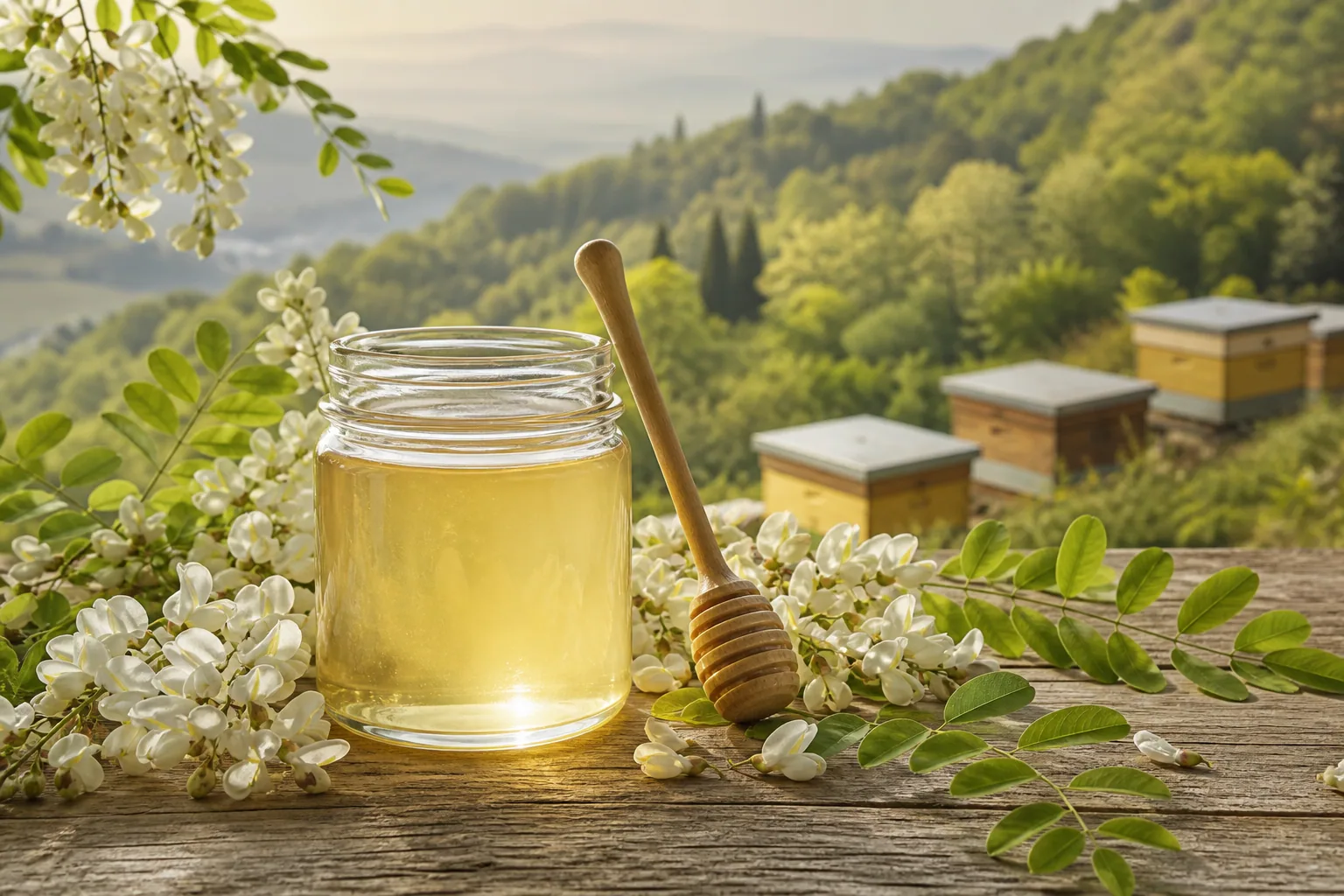
Quick answer
Tuscan acacia honey is generally pale, delicately aromatic and slower to crystallize than many other honeys. In Italy, acacia honey is associated with Robinia pseudoacacia, or black locust. A Tuscan origin claim does not automatically mean Miele della Lunigiana DOP: that protected name applies only to honey meeting its defined area and specification.
| Criterion | What it establishes | What it does not establish |
|---|---|---|
| Acacia honey | A botanical-origin claim associated in Italy with Robinia pseudoacacia. | That the honey came from the Acacia genus or will never crystallize. |
| Tuscan acacia honey | Acacia honey with a substantiated origin in Tuscany. | PDO certification or one identical flavor across the region. |
| Miele della Lunigiana DOP | Compliance with a protected designation, defined area and product specification. | A label available to every authentic acacia honey produced in Tuscany. |
What acacia honey means in Tuscany
In the Italian honey trade, acacia refers to honey produced wholly or mainly from Robinia pseudoacacia nectar. The tree is also known as black locust or false acacia. That botanical detail matters because the honey does not come from the Acacia genus familiar in other parts of the world.
A floral name is more than a poetic tasting term. Under EU honey rules, a product name may refer to a floral or vegetable origin when the honey comes wholly or mainly from that source and possesses the corresponding sensory, physicochemical and microscopic characteristics. A light color alone is therefore not enough to establish that a jar is acacia honey.
How Tuscan acacia honey typically tastes and looks
Acacia honey is generally among the palest Italian honeys. Official Tuscan material describing Miele della Lunigiana DOP acacia honey places its color between nearly colorless and straw yellow, with a light perfume and a distinctly sweet, delicate profile. Those protected-product characteristics are a useful regional reference, not a specification for every acacia honey harvested elsewhere in Tuscany.
Individual batches can still differ. Nearby flowers, the strength and timing of the main bloom, moisture, extraction and storage all influence the experience of a jar. Sensory language is also subjective: one person may notice vanilla-like softness while another simply experiences clean sweetness.
Its restrained profile makes acacia honey easy to use where a stronger honey might dominate. It can sweeten tea, yogurt or fresh cheese while leaving other flavors recognizable. Pairing suitability is a matter of preference rather than evidence of quality.
Why acacia honey often remains liquid longer
Acacia honey commonly stays fluid longer than many polyfloral honeys. Its natural sugar balance tends to slow crystallization, which is why consumers often associate it with a clear, pourable texture. “Slower” does not mean that crystallization is impossible or that every jar will remain visually unchanged.
Temperature, time, fine particles and crystals already present in the honey can influence when crystallization begins. A cloudy area or partial crystallization is not automatic evidence of adulteration or spoilage. Visit Tuscany notes that even protected Lunigiana acacia honey may sometimes appear cloudy because of incomplete crystallization.
If a jar crystallizes, place the closed container in gently warm water and allow the texture to soften gradually. High heat can damage aroma and heat-sensitive characteristics. Never use crystallization alone as a home purity test.
A valuable honey shaped by a short, weather-sensitive bloom
Acacia production depends on an overlap between flowering trees, colonies ready to forage and suitable flying conditions. A visually abundant bloom does not guarantee a strong crop. Rain can keep bees from flying, cold can limit nectar secretion and wind can shorten the useful flowering period.
This sensitivity explains why responsible beekeepers describe harvest expectations conditionally. The same landscape can produce different volumes and sensory results from one year to the next. A seasonal shortfall is not proof of poor care; it may be an honest consequence of weather and flowering.
BeePatron’s public Apiary Journal separates dated observations at Le Gusciane from general education. A future entry may document acacia conditions when there is approved, location-specific evidence, but an evergreen guide should never pretend to report what happened in a season before that evidence exists.
Tuscan acacia honey is not automatically Lunigiana PDO
Miele della Lunigiana DOP is a protected designation tied to a defined part of Massa-Carrara province. The protected name covers acacia and chestnut honey produced, processed and packed according to its specification in that geographical area.
Honey harvested elsewhere in Tuscany may still be authentic Tuscan acacia honey, but it cannot borrow the protected designation simply because its color or flavor resembles the Lunigiana product. Likewise, a Tuscan origin statement and an acacia floral statement answer two separate questions: where the honey was harvested and which nectar source predominates.
BeePatron’s partner apiary is at Le Gusciane in Camaiore, outside the defined Lunigiana production area. BeePatron should therefore describe plan-specific acacia honey through its verified origin and batch information, without implying the Lunigiana PDO designation.
How to choose a traceable Tuscan acacia honey
Begin with the label rather than color, viscosity or an online home test. Check the country of origin, producer or packer, lot information and any specific regional or botanical statement. EU rules allow regional and floral origin information under defined conditions; those details should be internally consistent and specific enough to verify.
Ask what the seller knows about the batch. A credible answer may include harvest area, beekeeper, season and whether the floral description belongs to that batch. Be cautious when a seller promises identical taste every year, treats permanent liquidity as proof of purity or uses Tuscany imagery without naming a real origin.
- ●Read the country-of-origin statement.
- ●Distinguish “acacia,” “Tuscan” and “Miele della Lunigiana DOP.”
- ●Look for a producer or packer and identifiable lot.
- ●Expect natural variation between seasons and batches.
- ●Do not authenticate honey through color or crystallization alone.
Sources and further reading
Primary and institutional references used to review the factual claims in this guide. Product details and prices are BeePatron information.
Frequently asked questions
Is acacia honey made from acacia trees?
In Italy and much of Europe, acacia honey is associated with Robinia pseudoacacia, commonly called black locust or false acacia. It is not produced from the Acacia genus used for some trees elsewhere.
Does real acacia honey crystallize?
It can. Acacia honey usually crystallizes more slowly than many other honeys, but time, temperature, batch composition and existing seed crystals can still change its texture.
Is all Tuscan acacia honey PDO certified?
No. Miele della Lunigiana DOP is a protected product from a defined geographical area and specification. Authentic acacia honey from another part of Tuscany is not automatically entitled to that designation.
What does Tuscan acacia honey taste like?
It is generally pale, sweet and delicately aromatic, but sensory characteristics vary by batch. Tasting notes are helpful descriptions rather than proof of origin.
How should acacia honey be stored?
Keep the jar tightly closed in a cool, dry place away from direct light and strong heat. Refrigeration is unnecessary and can encourage crystallization.
Follow the Story Behind Tuscan Honey
Explore a named-hive experience connected to seasonal beekeeping at Le Gusciane in Camaiore.
Compare adoption plans