
Honey Bee Biology
How Does a Bee Become a Queen? Egg to Adult
A queen and worker can begin with the same kind of fertilized egg. Learn how royal jelly, queen cells and colony conditions shape queen development.
Quick answer
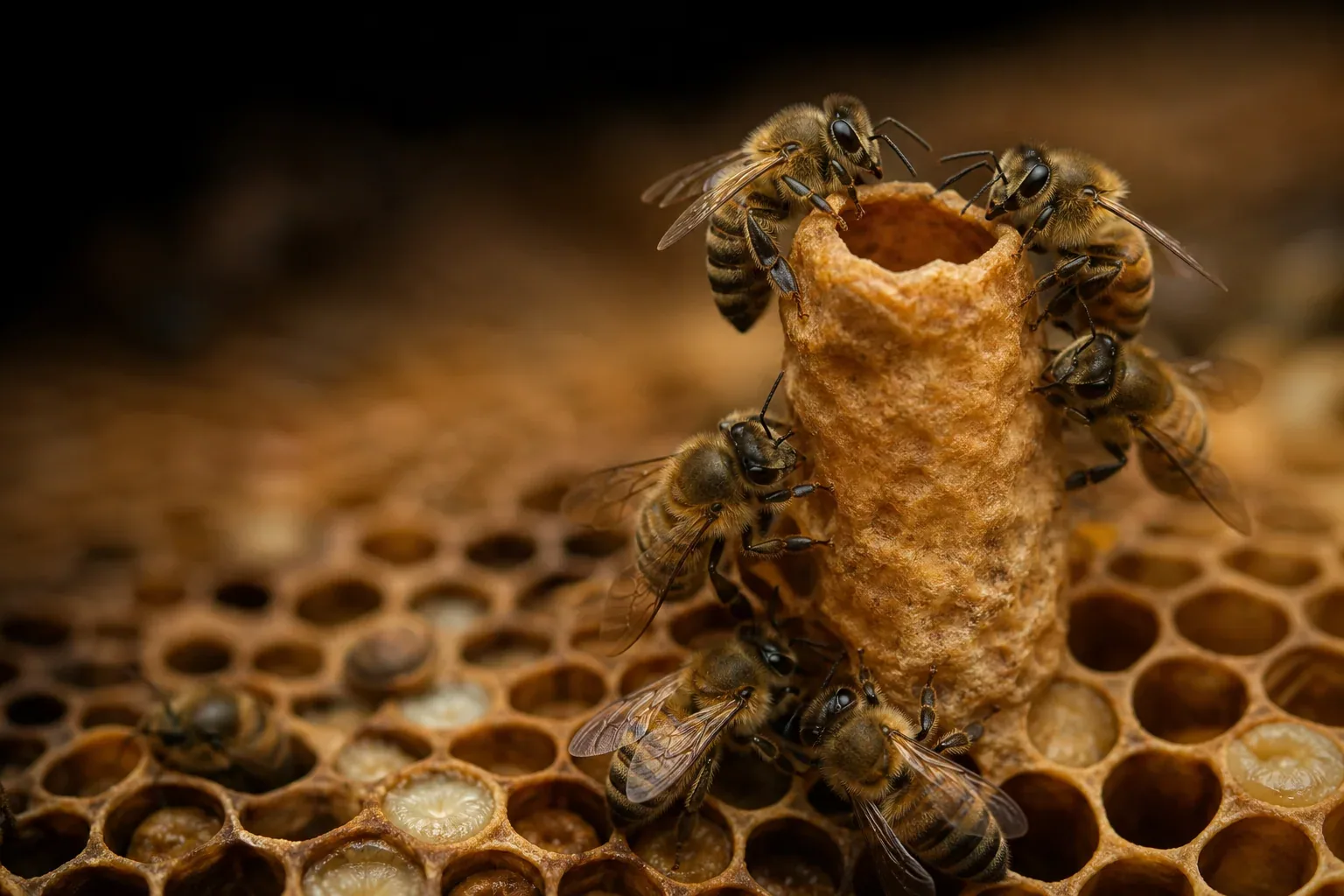
A honey bee becomes a queen when workers rear a young female larva in a queen cell and provide an abundant queen-development diet commonly called royal jelly. Queens and workers usually develop from fertilized eggs; the developmental pathway, not a special queen egg, creates the difference. Sustained nutrition changes growth, anatomy, gene activity and reproductive development. A queen typically emerges about 16 days after the egg is laid, although timing varies with biology and conditions.
| Criterion | Queen | Worker |
|---|---|---|
| Egg | Usually develops from a fertilized egg. | Usually develops from a fertilized egg. |
| Larval rearing | Raised in a vertical queen cell with abundant specialized food. | Raised in a worker cell on the worker developmental diet. |
| Development time | About 16 days from egg to emergence. | About 21 days from egg to emergence. |
| Adult role | Primary reproductive female and pheromonal center. | Brood care, comb work, defense, foraging and other colony tasks. |
Looking for an educational gift rooted in the real world?
Explore BeePatron’s named Tuscan hives and discover the meaning behind each one.
Explore the HivesA queen does not usually begin as a special queen egg
Worker and queen honey bees are both female and normally arise from fertilized eggs. Their major differences emerge after hatching. Workers alter the larva's environment, diet and cell, directing development toward a reproductive queen rather than a largely non-reproductive worker.
This developmental flexibility is called polyphenism: the same genome can produce markedly different adult forms in response to environmental inputs. Genetics still matters, but there is no universal queen-only gene that makes an ordinary egg destined for royalty from the moment it is laid.
Why does a colony start raising a queen?
Colonies rear queens in several contexts. Emergency queen cells can begin after the queen is lost. Supersedure cells appear when workers replace a failing queen. Swarm cells are associated with colony reproduction, when the old queen and many workers prepare to leave while new queens develop behind them.
The starting circumstances affect which young larvae are available and where cells are built, but every successful queen still requires careful feeding, temperature regulation and protection. Colonies may begin several queen cells even though normally only one new laying queen ultimately becomes established.
Royal jelly is important, but the story is not one magic ingredient
Nurse bees produce glandular secretions used to feed larvae. Queen-destined larvae receive an abundant, sustained queen-rearing diet commonly described as royal jelly. Worker larvae also receive brood food early in development, so the difference is not that only queens ever taste royal jelly; duration, quantity and composition of feeding matter.
Nutrition influences signaling pathways, metabolism, hormone activity and gene expression. Those interacting processes support the queen's larger ovaries, different body proportions, shorter developmental schedule and adult reproductive capacity. Popular explanations that credit one molecule alone oversimplify a colony-level developmental system.
The queen cell gives the larva a different nursery
A queen cell is larger and hangs vertically or downward from the comb. Its size accommodates the developing queen and the large food supply placed around her. The cell is capped while the larva spins a cocoon and transforms through the pupal stage.
Location can hint at context but is not a perfect diagnosis. Beekeepers interpret cell position together with colony condition, queen status, brood pattern and season. Opening or removing a queen cell without understanding why it exists can leave a colony queenless.
Queen development timeline: about 16 days
The egg stage lasts roughly three days. The larva then feeds and grows rapidly before the queen cell is capped, commonly around day eight after laying. Metamorphosis continues inside the capped cell, and the adult queen often emerges around day sixteen. These are practical averages rather than guarantees to the hour.
A newly emerged queen is not immediately a proven laying queen. She matures, may take orientation and mating flights when weather permits, and then begins laying if mating and establishment succeed. That transition can take days or longer, and not every virgin queen returns or becomes productive.
- ●Days 0–3: fertilized egg
- ●Days 3–8: intensively fed larva in a queen cell
- ●Around day 8: cell capped
- ●Around day 16: adult queen emerges
- ●After emergence: maturation, mating flights and eventual egg laying
What happens when more than one queen emerges?
Multiple queen cells create competition. A first-emerging queen may damage rivals still inside their cells, and virgin queens can fight. During swarming, however, secondary swarms may leave with additional virgin queens. The outcome depends on colony state rather than a fixed ceremonial succession.
Once established, the queen becomes the colony's principal egg layer and an important source of pheromones, but she does not command workers like a human monarch. Colony organization emerges from chemical signals, worker interactions, brood needs and environmental conditions.
Sources and further reading
Primary and institutional references used to review the factual claims in this guide. Product details and prices are BeePatron information.
Frequently asked questions
Are queen bees born or made?
Queens are made through development. A young female larva is reared in a queen cell on a sustained queen-development diet, producing a different adult from a worker.
Can any female bee become a queen?
Only a sufficiently young female larva has the developmental flexibility needed. An adult worker cannot later transform into a queen.
Do worker bee larvae eat royal jelly?
Young worker larvae also receive glandular brood food. Queen development depends on sustained differences in feeding quantity, duration and composition, not a simple never-versus-once distinction.
How long does it take to make a queen bee?
A queen commonly emerges about 16 days after the egg is laid. She then needs time to mature, mate successfully and begin laying.
Follow the seasons of a real apiary
Explore named-hive patronage and learn how colony life changes through the year.
Choose a Hive Give BeePatron as a Gift