
Honey Bee Behavior
How Do Honey Bees Communicate? Dance, Scent, Touch and Vibration
The waggle dance is only the beginning: discover how a dark hive exchanges information about flowers, danger, queens, food, nest sites and colony needs.
Quick answer
Honey bees communicate through several overlapping channels. Foragers use round and waggle dances to recruit nestmates to resources; the angle and duration of a waggle run encode direction and distance. Odor and nectar samples help recruits identify the target. Pheromones coordinate queen presence, alarm, orientation, brood care and other colony functions. Bees also exchange information through antennal contact, food transfer, buzzing and vibrations transmitted through wax comb. No single signal controls the hive—the colony integrates many local interactions.
| Criterion | Information carried | How bees receive it |
|---|---|---|
| Dance | Direction, distance and recruitment value for food, water or nest sites. | Followers track movement through close contact, vibration and sound in the dark hive. |
| Pheromones | Queen state, alarm, orientation, brood needs and colony recognition. | Antennae detect chemical blends distributed through air and contact. |
| Taste and odor | Identity and quality clues associated with nectar and flowers. | Recruits sample food and smell the returning forager before searching outside. |
| Vibration and touch | Activation, inhibition, coordination and local task information. | Legs, antennae and other sensory structures detect comb-borne or direct signals. |
A colony communicates in darkness
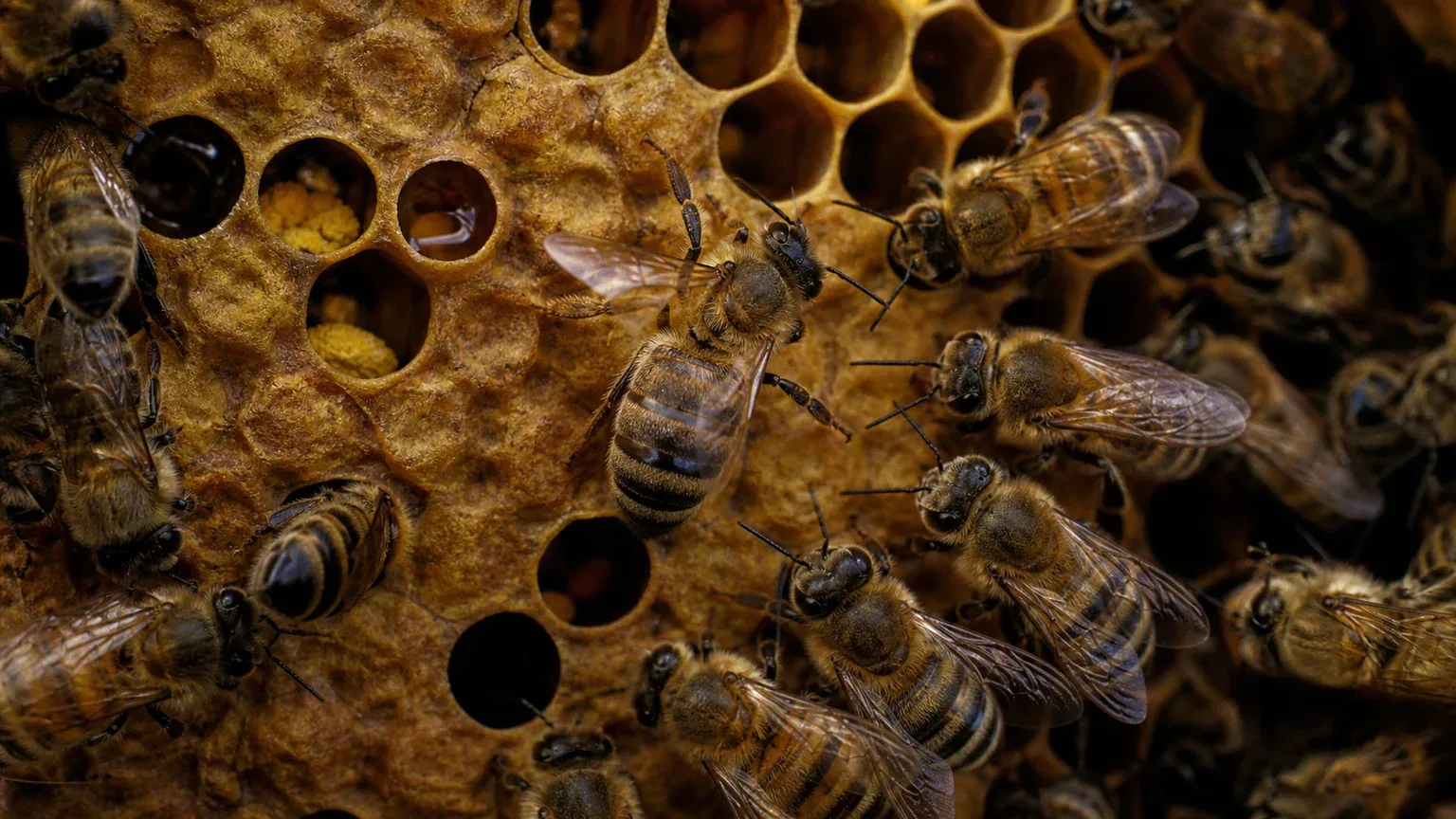
Much of honey bee life unfolds between closely spaced sheets of wax comb where vision is limited. Tens of thousands of workers may need to adjust foraging, feeding, ventilation, brood care and defense without a central dispatcher. Communication therefore relies heavily on chemical cues, vibration, sound, taste and direct contact.
The colony behaves less like a company receiving orders and more like a distributed information system. Individual bees respond to local cues: an empty cell, a hungry larva, nectar offered by a forager, alarm odor at the entrance or vibration on the comb. Repeated interactions scale into coordinated colony behavior.
This matters when interpreting famous signals. The waggle dance is extraordinary, but it does not operate alone. A recruit combines dance information with floral odor, remembered landscape, weather and her own search outside.
The round dance recruits to nearby resources
A forager returning from a profitable nearby source may run in compact circles, repeatedly changing direction. This round dance stimulates other foragers to search close to the colony but does not provide the precise directional code associated with a waggle dance.
Recruits can taste a nectar sample and detect the flower odor carried by the dancer. Once outside, those sensory clues help them find the relevant plants. The distance at which dance forms transition is not a universal hard boundary; honey bee subspecies and conditions vary, and intermediate forms occur.
The waggle dance encodes distance and direction
For a more distant resource, a worker repeats a figure-eight-like route with a vibrating straight segment called the waggle run. The run's orientation on vertical comb represents the direction of travel relative to the sun. A run directed upward indicates travel toward the sun's azimuth; an angle away from vertical maps to the same angle away from the sun outside.
The duration of the waggle run correlates with distance. Longer runs generally indicate a more distant target, while dance vigor and repetition contribute to recruitment strength. The code is not a GPS coordinate with identical precision in every performance; followers average variable runs and then search in the indicated area.
The sun moves while bees forage, yet experienced dancers adjust over time using an internal clock. On cloudy days, honey bees can use patterns of polarized light where available and remembered landscape information, though the full navigation system extends beyond the dance itself.
How followers read a dance they can barely see
Dance followers position themselves close to the dancer, often contacting her with their antennae. They detect body motion, air movement, buzzing and vibrations transmitted through the comb. The sensory experience is multimodal rather than a bee simply watching a visible diagram.
A follower may attend several waggle runs before leaving. Not every follower becomes a recruit, and not every recruit finds the source. Colony foraging remains flexible because workers compare signals, previous experience and what they encounter outside.
The dance advertises value as well as location
A rich, concentrated nectar source generally elicits more persistent recruitment than a poor one. Foragers also respond to unloading delay inside the colony: if receiver bees accept nectar quickly, continued collection is encouraged; if unloading is slow because storage or processing capacity is saturated, recruitment can weaken.
This feedback allows the colony to allocate labor without calculating a written budget. Dancers promoting different patches effectively compete for followers, while changing nectar quality, distance and risk alter the strength of each signal.
Bees can tell recruitment to slow down
Communication includes inhibition as well as enthusiasm. A worker can deliver a brief vibrational stop signal, often while contacting a dancing bee. Research links this signal to reduced waggle dancing when a resource is dangerous, crowded or contested.
The signal does not describe a threat in words. It changes the probability that recruitment continues, helping the colony redirect effort. This push-and-pull between positive dances and negative signals is one reason colony decisions can adapt quickly.
Pheromones organize the colony chemically
Pheromones are chemical signals released by one bee and detected by others of the same species. Queen-associated blends help communicate her presence and reproductive condition. Workers spread those compounds through contact as they move around the colony; changes in distribution can contribute to queen rearing and other responses.
Alarm pheromones mobilize defense and can mark a sting site. Nasonov pheromone helps workers orient and assemble at an entrance, water source or swarm location. Brood produces chemical information related to its presence and needs. These are blends interpreted in context, not simple one-chemical commands.
Smoke changes defensive communication partly by interfering with alarm cues and encouraging bees to consume honey, but it is a professional management tool rather than a harmless perfume. Beekeepers use as little cool smoke as the situation requires.
Food transfer also transfers information
During trophallaxis, one bee passes liquid food to another. The exchange distributes nectar and nutrients while sharing taste and odor information. A receiver learns something about incoming forage; a forager receives feedback through how quickly her load is accepted.
Contact networks also spread queen-associated compounds and colony odor. Communication is embedded in ordinary work: feeding, grooming, antennation and walking across comb continually update bees about their neighbors and nest.
The queen communicates, but she does not command
A queen's pheromone blend influences worker physiology and behavior and signals reproductive presence. That does not make her the hive's manager. She does not assign foragers, direct comb construction or choose a flower patch.
Workers collectively regulate most tasks through age, physiology and local conditions. Even queen replacement is a colony process: workers build and provision queen cells when signals and circumstances indicate swarming, supersedure or queen loss.
A swarm uses communication to choose a new home
When a swarm clusters temporarily, scout bees inspect possible nest cavities and return to dance for their discoveries. Competing dances rise or fade as more scouts examine the options. Quorum-like processes help the swarm converge on a site before departure.
The same directional language used for flowers can therefore recruit to real estate. The decision is collective: no scout begins with complete control, and the queen is not leading an aerial search for an address.
What the waggle dance does not mean
A waggle dance is not proof that every recruited bee will follow the exact route. It does not label the plant in abstract vocabulary, predict the future quality of the patch or guarantee that the resource is safe. Odor, experience and direct exploration complete the task.
Calling it a language is useful because the dance symbolically represents distance and direction, but comparisons with human grammar can overreach. Honey bee communication is remarkable on its own terms: a specialized system evolved for the problems of colony life.
Sources and further reading
Primary and institutional references used to review the factual claims in this guide. Product details and prices are BeePatron information.
Frequently asked questions
What does the waggle dance tell other bees?
The orientation of the waggle run represents direction relative to the sun, while its duration correlates with distance. Repetition and vigor help influence recruitment.
Can bees communicate in the dark?
Yes. They use close contact, antennae, comb vibration, buzzing, odor, taste and pheromones, so communication does not depend on seeing the dance clearly.
Do bees talk with sound?
Honey bees produce buzzing and vibrational signals, but these work alongside touch, movement and chemical cues rather than forming spoken language.
How do bees warn each other about danger?
Alarm pheromones recruit defense, while stop signals can inhibit recruitment to a dangerous resource. Context and repeated local interactions shape the response.
Does the queen tell worker bees what to do?
No. Queen pheromones communicate reproductive presence and influence colony organization, but worker tasks emerge mainly from age, physiology and local colony conditions.
Do bumblebees perform a honey bee waggle dance?
No. The symbolic distance-and-direction dance described here is characteristic of honey bees; other social bees use different recruitment and information systems.
Follow a Colony's Seasonal Decisions
Choose a named Tuscan hive and discover how weather, forage and colony behavior shape each chapter.
Compare adoption plansContinue exploring
How Bees Make Honey
Follow recruited foragers' nectar from flower to capped comb.
Read nextWhat Does a Queen Bee Do?
Understand the queen's chemical and reproductive role.
Read nextWhy Honey Bees Swarm
See how dance communication helps a swarm choose a home.
Read nextA Year in the Life of a Beehive
Place communication inside the changing seasonal colony.
Read next