
Inside the Colony
What Does a Queen Bee Actually Do? Life, Mating and Colony Role
Move beyond the royal metaphor to understand how a queen develops, mates, lays eggs, produces pheromones and is replaced by the worker colony.
Quick answer
A honey bee queen is the colony's principal egg-laying female. After developing in a queen cell, a virgin queen typically takes mating flights and stores sperm for later use. A mated queen lays fertilized eggs that become workers or queens and unfertilized eggs that become drones. Her pheromone blend communicates reproductive presence and affects worker physiology and behavior, but she does not command daily tasks. Workers feed and groom her, regulate colony work and may raise a replacement during swarming, supersedure or queen loss.
| Criterion | Primary role | Common misconception |
|---|---|---|
| Queen | Reproduction, egg laying and queen-associated chemical signaling. | She does not direct every worker or make the colony's daily decisions. |
| Worker | Brood care, comb, food processing, ventilation, hygiene, defense and foraging. | Workers are female but usually do not reproduce in a queenright colony. |
| Drone | Male whose reproductive role is mating with a queen from another colony. | Drones do not forage, make honey or serve as hive guards. |
The queen is not the hive's ruler
The title queen invites a human political story: one female governing obedient subjects. Honey bee biology is different. The queen is essential because she is usually the colony's only fully reproductive female, but she does not plan foraging, supervise nursing or order workers to build comb.
Colony activity emerges from worker age, physiology, pheromones, brood signals, food stores, temperature and local contact. The queen contributes powerful reproductive and chemical information inside that system. Calling her an egg-laying organ of the colony is closer than calling her a monarch, though even that shorthand cannot capture every interaction.
Queens and workers begin from fertilized eggs
A female larva can develop toward queen or worker form depending largely on how workers house and feed her. Queen-destined larvae receive abundant specialized glandular food in vertically oriented queen cells. Nutrition alters development, anatomy and reproductive capacity.
This is not a case of one genetically predetermined royal egg in ordinary colony reproduction. Workers select young female brood under the circumstances of swarming, supersedure or emergency replacement. Genetics still matter, but developmental environment creates the caste difference.
A queen develops faster than a worker
A western honey bee queen generally emerges about 16 days after the egg is laid, compared with roughly 21 days for a worker under typical conditions. Temperature, genetics and measurement conventions can introduce variation, so the familiar day counts are useful biological averages rather than appointment times.
The queen larva grows in an elongated cell that often resembles a peanut shell when capped. After pupation and emergence, the virgin queen is not yet a productive layer. Her reproductive system must mature and mating must occur under suitable conditions.
What happens when several queens develop
Colonies commonly begin more queen cells than will ultimately provide a laying queen. An emerged virgin may destroy rivals still inside cells, and queens can fight when they meet. In swarming colonies, workers may temporarily regulate queen emergence as additional swarms become possible.
The familiar claim that the first queen always kills every rival is therefore too absolute. Outcome depends on colony condition, worker behavior and whether the colony is continuing a reproductive swarm sequence.
A virgin queen mates away from the hive
After orientation flights, a virgin queen flies to mate in the air with multiple drones, typically in drone congregation areas. Weather, season, drone availability and queen condition affect success. Mating with multiple males increases genetic diversity among worker patrilines within the colony.
The queen stores sperm in an organ called the spermatheca and uses that reserve across her egg-laying life. Drones die after successful mating. The queen usually does not continue routine mating throughout every season, which makes early mating quality important to her later performance.
How the queen lays worker and drone eggs
A laying queen examines a cell and deposits one egg. Fertilized eggs develop into females—workers under ordinary feeding or queens under queen-rearing conditions. Unfertilized eggs develop into male drones through haplodiploid sex determination.
At seasonal peak, a strong queen may lay a very large number of eggs, sometimes reported around or above her body weight per day, but production changes with genetics, nutrition, colony population, weather and available comb. One impressive maximum should not be treated as her constant daily output.
A compact, appropriately placed brood pattern can indicate good function, while gaps can have many causes including queen performance, disease, chilled brood, hygienic removal or limited resources. Beekeepers interpret the whole colony rather than diagnosing from one photograph.
Why workers form a retinue around her
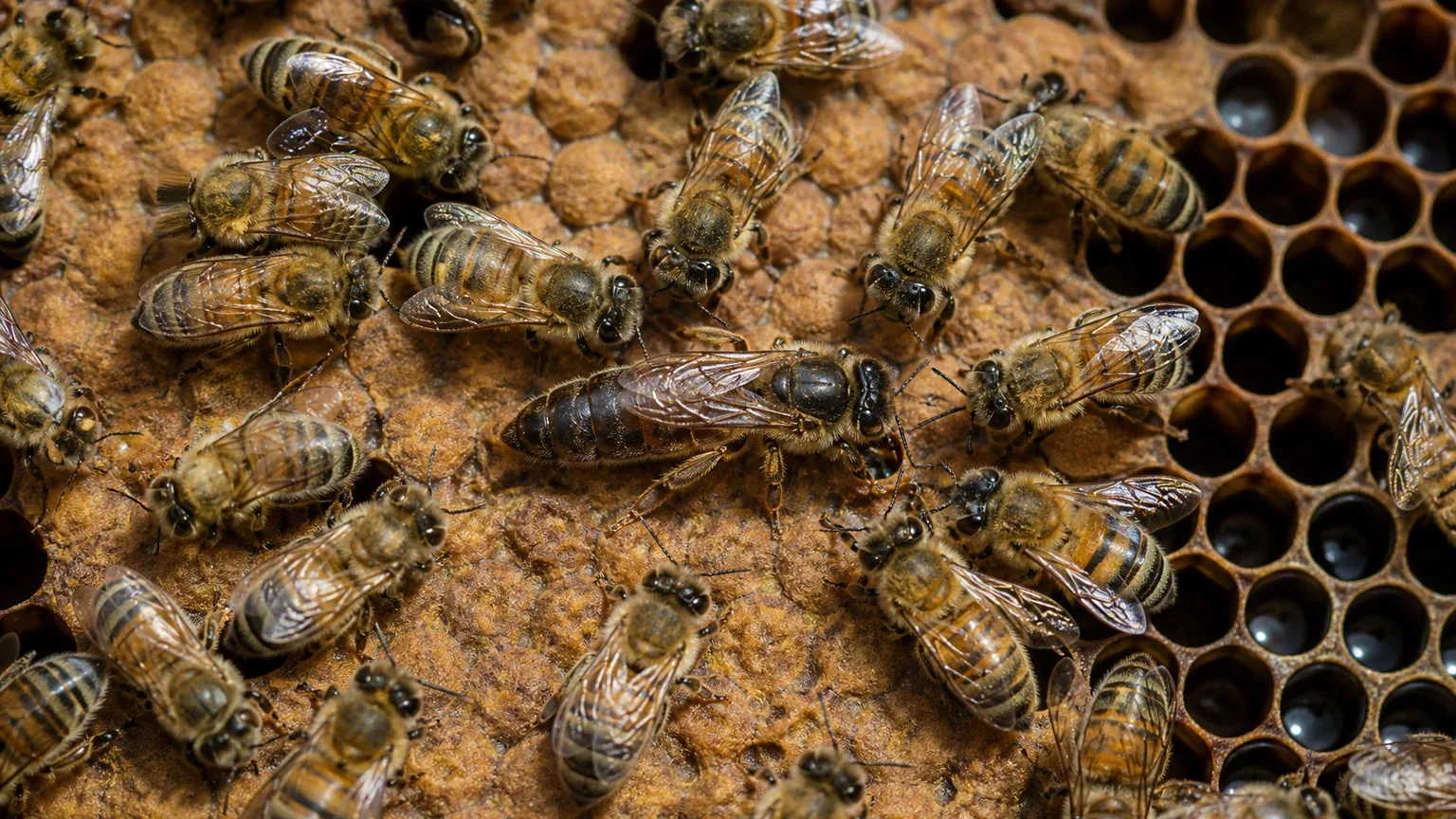
Attendant workers face the queen, touch her with their antennae, feed her and groom her. Through contact they acquire queen-associated pheromones and distribute them as they move through the colony.
The retinue is not a ceremonial court. It supports a highly productive reproductive female and circulates information about her presence and condition. The size and persistence of the retinue can change with queen state and pheromone profile.
Queen pheromones are signals, not mind control
The queen produces a complex blend from several glands. Queen mandibular pheromone is one well-studied part, but not the entire signal. Mating changes the blend, and workers respond through behavior and physiology.
Queen-associated pheromones help inhibit worker queen rearing under normal conditions, attract attendants and contribute to social organization. Their distribution depends on contact and worker movement. When the signal weakens because the queen is failing, absent or separated, workers can respond by initiating replacement.
Three reasons a colony raises a new queen
During swarming, the colony prepares queen cells before the existing queen departs with part of the workforce. During supersedure, workers replace a queen whose performance or signals are inadequate. During emergency queen rearing, sudden queen loss prompts workers to use suitably young female larvae already present.
Emergency timing is constrained by brood age. A colony without young fertilized larvae cannot simply create a queen from an old worker or an empty cell. Beekeepers diagnosing queenlessness must consider eggs, larval age, queen cells and the time since the last inspection.
How long does a queen live?
A queen can live for several years, longer than most workers, but longevity is not the same as sustained performance. Stored sperm, disease, injury, nutrition and egg-laying capacity can decline. Colonies may supersede a queen, and beekeepers may replace queens according to management goals.
There is no responsible universal rule that every queen must be replaced annually or kept as long as she remains alive. Local conditions, colony behavior, breeding strategy and welfare guide the decision.
How beekeepers find—or infer—the queen
A queen is usually longer than workers, with an abdomen extending beyond her folded wings and a smoother-looking thorax. She may move steadily across brood comb while attendants orient around her. Paint marks used by some beekeepers aid identification but are not natural anatomy or proof of quality.
Finding her is not always necessary. Fresh eggs, young brood and an organized colony can confirm recent queen activity with less disturbance. Skilled inspection asks the management question first instead of turning every visit into a queen hunt.
Sources and further reading
Primary and institutional references used to review the factual claims in this guide. Product details and prices are BeePatron information.
Frequently asked questions
What is the queen bee's main job?
She is the colony's principal reproductive female, laying eggs and producing pheromone blends that communicate her presence and reproductive state.
Does the queen control worker bees?
No. Her chemical signals influence colony organization, but workers regulate daily tasks through local cues, age, physiology and colony conditions.
How is a queen bee made?
Workers place or select a young fertilized female larva in a queen cell and feed it abundantly with specialized glandular food, producing queen development rather than worker development.
How long does a queen take to develop?
A western honey bee queen typically emerges about 16 days after the egg is laid, though biological conditions can shift timing.
How many queens live in a hive?
A stable western honey bee colony usually has one mated laying queen, although short transition periods can involve queen cells, virgin queens or occasional overlap during replacement.
Can a hive survive without a queen?
Workers may raise a replacement if suitably young fertilized brood is present. Without successful replacement or beekeeper intervention, the colony cannot sustain its worker population indefinitely.
Meet the Living Colony Behind a Named Hive
Follow a professionally managed Tuscan hive through queen-led reproduction, worker activity and the changing season.
Compare adoption plansContinue exploring
How Honey Bees Communicate
Understand queen pheromones inside the colony's wider information network.
Read nextWhy Honey Bees Swarm
Follow what happens to the old queen and developing replacements.
Read nextA Year in the Life of a Beehive
See how queen laying changes with season and forage.
Read nextHow Bees Make Honey
Meet the workers whose coordinated labor produces the colony's stores.
Read next