
Apiary Booking Guide
How to Choose an Apiary Tour: 15 Questions Before You Book
Compare apiary tours and beekeeping experiences by safety, group size, live-hive access, equipment, accessibility, tasting, weather policy and responsible claims.
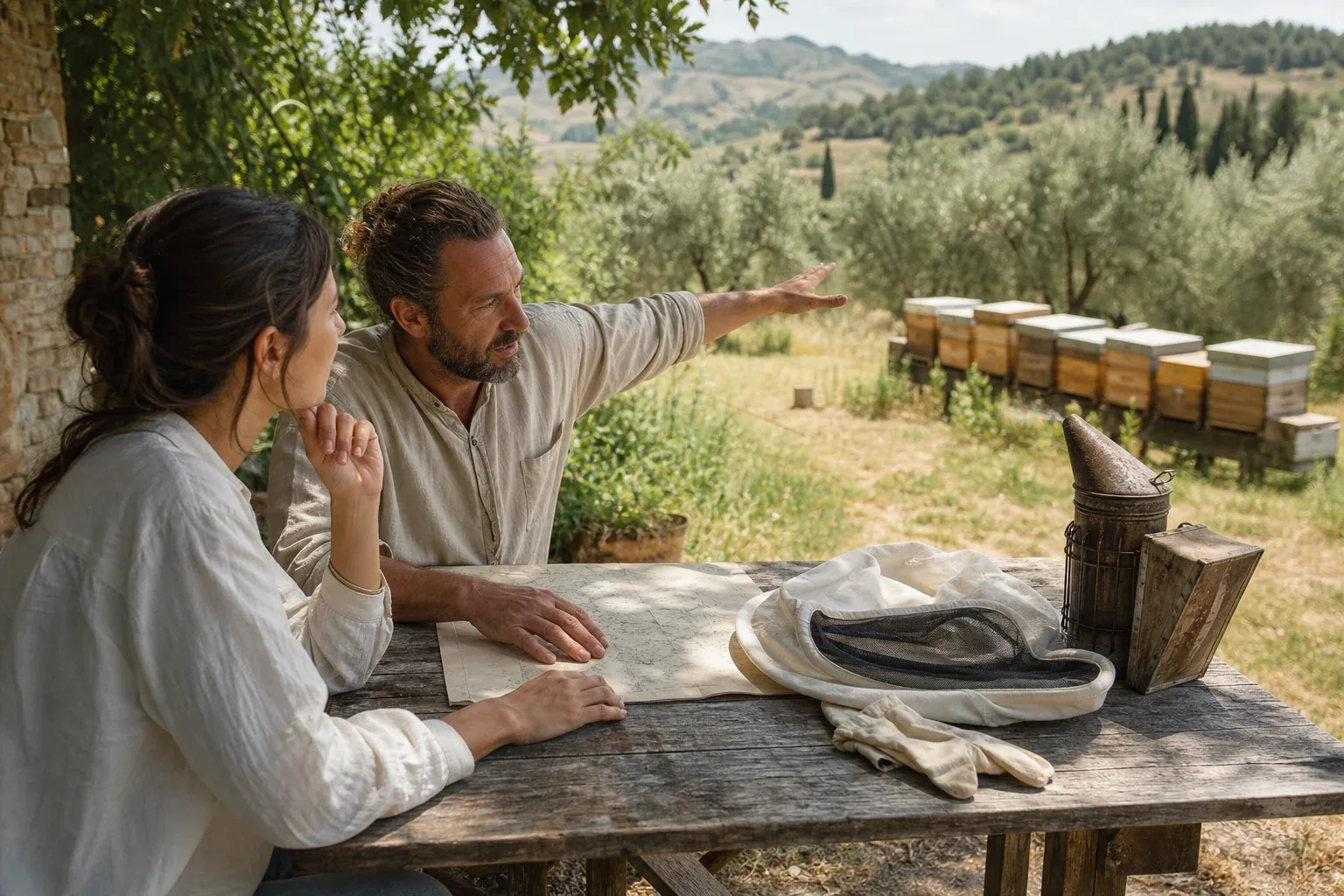
Quick answer
Choose an apiary tour by asking who leads it, how large the group is, what happens near live colonies, which equipment is supplied and what changes in poor weather. Confirm age, allergy and accessibility policies; exact tasting or product inclusions; language; duration; transport; and cancellation terms in writing. Prefer a host who explains uncertainty and colony-first limits over one who guarantees hive openings, queen sightings or honey harvests.
| Criterion | Reassuring answer | Reason to ask more |
|---|---|---|
| Live-hive access | Planned when conditions and colony welfare allow. | Guaranteed regardless of weather or colony condition. |
| Safety | Briefing, fitted equipment and a clear exit procedure. | Protective clothing is presented as eliminating all sting risk. |
| Inclusions | Activities, tasting and products are named precisely. | A vague premium package with no itemized format. |
| Environmental claims | Specific practices and modest language. | The booking is sold as an offset or guaranteed biodiversity result. |
Begin by translating the listing into actual activities
Apiary tour, bee experience, beekeeper for a day and honey visit are not standardized formats. One may involve protective clothing beside live colonies; another may focus on a honey room or tasting. Neither is inherently better, but the buyer should know which one is being sold.
Ask the host to describe the experience in sequence from arrival to departure. That simple request exposes hidden assumptions about access, duration and participation.
1–3: Who leads the visit, how large is the group and in which language?
Ask whether the guide is the beekeeper responsible for the apiary or an interpreter working with them. Confirm the maximum group size, especially if you want time for questions or have access needs.
Language matters around live colonies because safety instructions must be understood immediately. If interpretation is used, ask how the briefing and urgent directions are handled.
4–6: How close do visitors go, can a hive be opened and what can change?
Clarify whether the itinerary enters the beeyard, watches entrances from outside, uses an observation hive or stays in a processing space. If a live hive may be opened, the host should reserve the right not to proceed when weather or colony condition makes it inappropriate.
Be cautious with guaranteed queen sightings, frame handling or harvesting. These are biological and operational events, not performances that every colony owes a visitor.
7–9: What equipment is supplied, what must you wear and what is the sting procedure?
Confirm whether the host provides a veil, jacket, full suit and gloves, and whether your size is available. Ask separately about trousers, socks and closed shoes because supplied protective equipment may not cover them.
An honest host will not call the experience sting-proof. They should explain the briefing, how visitors leave the beeyard and what the group does if a sting or defensive behavior occurs.
10–11: What are the age, health and accessibility policies?
Provide children's ages, relevant sting-reaction history and mobility or sensory needs before paying. Ask about uneven ground, heat, shade, seating, toilets and distance from parking.
A modified experience can be excellent when agreed in advance. A vague promise that everyone will manage on arrival transfers planning risk to the visitor.
12–13: Are tasting and take-home products truly included?
Honey tasting, cheese pairing, extraction demonstrations and take-home jars are separate inclusions. Confirm each one rather than inferring it from apiary imagery. Ask about food-allergy information and whether substitutions are available.
Seasonal or small-batch production means a host may not offer honey from a particular hive or date. Responsible provenance is more credible than impossible exclusivity.
14–15: What is the weather plan and cancellation policy?
Ask when the go-or-no-go decision is made, how the host contacts visitors, what alternative is offered and whether payment can be moved to another date. Check your own travel constraints before accepting a reschedule-only policy.
Save the written confirmation, exact meeting point and contact number. Rural addresses, gates and parking areas may not be obvious from a map pin.
Read sustainability and ownership claims carefully
A visit can support a beekeeper, deepen ecological literacy and connect people to a managed landscape. It does not automatically offset travel, prove a biodiversity gain or transfer legal ownership of a colony.
Prefer hosts who describe concrete practices, limits and provenance. Precision is a premium signal; sweeping impact language is not.
A practical three-column shortlist
Compare no more than three experiences. Record the live-bee format, visitor-care details and total logistics for each. The best option is the one whose format fits your group—not automatically the longest or most expensive.
- ●Experience: sequence, live-hive access, guide and group size
- ●Visitor care: equipment, age policy, accessibility and weather plan
- ●Logistics: total duration, meeting point, language, price and cancellation terms
Sources and further reading
Primary and institutional references used to review the factual claims in this guide. Product details and prices are BeePatron information.
Frequently asked questions
What should a good apiary tour include?
It should clearly state the guide, group size, sequence, safety briefing, equipment, live-hive conditions, duration and weather policy. Tasting and products are optional and should be explicit.
Is an apiary tour the same as a beekeeping experience?
Not necessarily. These labels are not standardized, so compare the actual activities rather than relying on the title.
Should an apiary tour guarantee that a hive will be opened?
No. Weather, season and colony welfare can make opening a hive inappropriate, and a responsible host keeps the final decision.
How far ahead should I book a Tuscany apiary visit?
Book in advance and reconfirm near the date. Lead times vary by host, season and group needs, so ask directly rather than relying on a universal rule.
Are premium apiary tours always private?
No. Premium describes positioning, not group format. Confirm whether the visit is private, shared and subject to a maximum size.
Choose a Tuscany Experience With a Real Place Behind It
See how BeePatron connects named-hive patronage, private seasonal context and the Le Gusciane landscape.
Explore the Tuscany Experience