After the Harvest
What Happens After the Honey Harvest? A Beekeeper's Next Steps
The last filled jar is not the end of the beekeeping year. Understand the colony checks, careful decisions and packing work that follow a honey harvest.
Quick answer
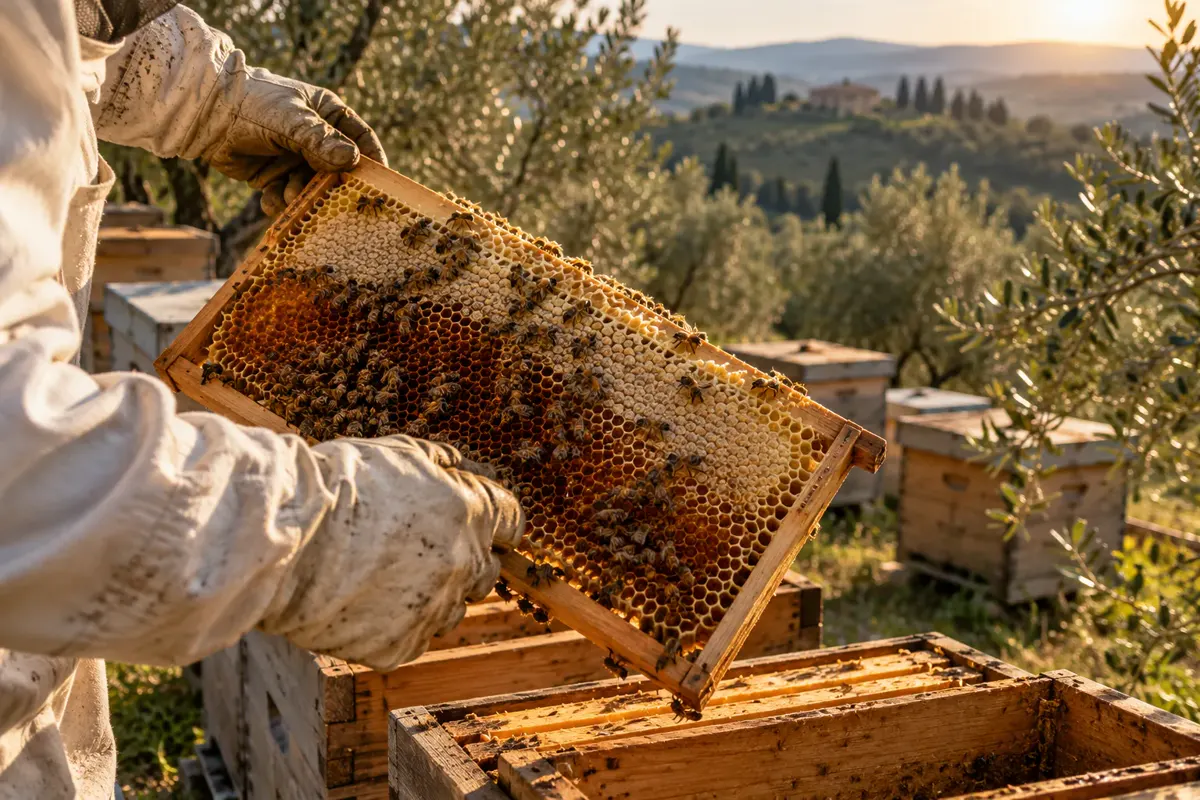
After a honey harvest, the beekeeper's attention returns to the colony. They assess whether enough food remains, check population and queen status, monitor Varroa mites, manage extracted comb and prepare colonies for the next season. Meanwhile the human food side of the work continues: honey is handled, settled, packed and labeled by batch. The order and timing vary with local flowering and weather. A harvest is one point in a living annual cycle, not the moment when care for the hive ends.
The harvest begins with a decision about what stays
Honey is the bees' stored food, so a responsible harvest begins by distinguishing appropriate surplus from the stores the colony may need. A full-looking frame alone does not tell you what the whole hive can spare. The beekeeper considers colony strength, remaining stores, local flowering and the season ahead before deciding what to remove.
The calendar cannot make that decision by itself. Penn State's seasonal guide explains that colonies rely on stored honey when floral resources diminish and that autumn inspections focus on food and population. Its examples come from Pennsylvania, so the dates should not be copied onto a Tuscan apiary. The management questions, however, explain why a beekeeper keeps working after extraction.
Check the colony after the supers come off
A beekeeper observes whether the colony has a functioning queen, an appropriate brood pattern, enough workers and adequate food. A weak colony and a strong colony may need different attention, even when they stand in the same apiary. Those judgments involve opening a hive when conditions are suitable and interpreting several signs together rather than counting bees at the entrance.
It is tempting to turn any pause in foraging into a diagnosis, but bees respond to temperature, wind and available flowers. A quiet entrance does not by itself prove a colony is failing. The meaningful story is the beekeeper's assessment over time. A patron can learn from a seasonal update without expecting a daily inspection report or a guarantee that nature behaves predictably.
Monitor Varroa as winter bees develop
Varroa mites are a serious challenge for managed honey bees. They reproduce in brood cells and are associated with viral disease. Penn State describes late summer and fall as important periods for assessing mite levels because the workers that will carry the colony toward spring are developing. Waiting for visible trouble can miss the period when action matters most.
Approaches to monitoring and management depend on local guidance, measured mite levels, the product label and whether honey supers are present. This article is an explanation of the work, not a treatment instruction. The important point for a honey recipient is that the beekeeper's priority shifts from collecting a crop to supporting the colony through the next stage.
Assess food stores without assuming a second crop
Late blooms may provide nectar, but their timing and strength vary. Some regions have a substantial fall flow; others do not. Beekeepers evaluate the weight and distribution of food stores and decide whether intervention is needed. A harvest quantity for customers is therefore not a simple multiplier of how many hives appear in an apiary.
Where feeding is necessary, it is a management measure for the bees, not a way to manufacture a jar for sale. Handling and harvest boundaries must remain clear. The Penn State seasonal guide notes that weak or light colonies may need support, but any real decision belongs to the responsible beekeeper in the local conditions. That is also why a credible program avoids promising a fixed yield from one named colony.
Care for extracted comb and equipment
After extraction, reusable comb, boxes, tools and food-handling equipment all need attention. Comb can be valuable to a colony because building it requires resources; improper storage can invite damage or pests. A Michigan State University Extension response describes several ways beekeepers handle extracted supers and notes that leaving them exposed as a public robbing station can create disease-transmission concerns.
There is no need for a patron to turn that answer into a checklist for Le Gusciane. Equipment choices depend on the apiary's setup and local conditions. The point is more concrete: the harvest leaves behind physical work. Clean equipment and thoughtful comb management belong to the next season's preparation, even though they rarely feature in a photograph of a finished jar.
Follow the separate journey from extraction to jar
Honey destined for people needs careful handling after it leaves the frame. Producers may strain out larger wax particles, allow bubbles to settle and pack the honey in clean containers with useful batch and origin details. Those steps take time beyond the day of extraction. They also explain why a gift invitation can arrive before a physical honey shipment.
A batch label or producer record gives a more honest connection to place than a promise that every spoonful came from one selected hive. Honey is produced in a working apiary under changing flowering and harvest conditions. Ask what the present package includes and read the shipping information for the actual destination and timing, rather than inferring a delivery date from the season alone.
What a patron can follow after harvest
A seasonal update might explain packing progress, changing forage or preparation for colder weather. It should report what is actually known, not imply that a picturesque photo proves the state of every colony. The quieter parts of the season can be as interesting as a harvest: the beekeeper is making decisions about food, health and timing while the recipient waits for the jar.
For someone interested in the source of their honey, that continuing story is part of the gift. BeePatron connects the recipient with a named hive at Le Gusciane and a private Hive Room. BeePatron is a patronage experience in Tuscany. Patronage does not transfer legal ownership. Honey comes from the supported apiary according to the selected package, harvest and season. The program should be judged by the real experience and the plan details, not by an exact-hive yield claim.
Sources and further reading
Primary and institutional references used to review the factual claims in this guide. Product details and prices are BeePatron information.
Frequently asked questions
Do beekeepers stop working once the honey is harvested?
No. They still assess stores, colony condition and mite levels, manage equipment and prepare for the next season. Honey handling and packing continue on a separate track.
Is all the honey removed from a hive?
A responsible beekeeper considers what the colony needs and harvests appropriate surplus. The amount that can be removed varies with colony strength, forage and seasonal conditions.
Why can honey shipping take longer than a gift email?
A digital invitation and a physical harvest shipment follow different processes. Extraction, handling, packing and delivery occur on their own timetable, so check current shipping guidance.
Does a named hive produce the exact jar a patron receives?
A name connects a patron to a hive story. BeePatron honey comes from the supported apiary according to the selected package, harvest and season, rather than exclusively from one chosen colony.
Your next chapter starts in Tuscany
Turn your next spoonful into a Tuscany story.
Adopt a named hive at Le Gusciane, follow its seasons in your private Hive Room and receive premium raw Tuscan honey with a personalized label.
Choose your package, then select your hive name in your private Hive Room after adoption.
Your connection to Tuscany
Hive Experience
$129USD
One payment · One full year
- Live apiary camera & your private Hive Room
- Seasonal stories from your beekeeper
- Personalized digital & printed certificates
1.1–4.4 lb of premium raw Tuscan honeyAnnual harvest shipment. Amount depends on the harvest.
Shipping included
Tuscany, shared together
Family Hive Experience
$229USD
One payment · One full year
- Twice the honey range, with Wildflower & Acacia
- Honey recipes & digital Guided Honey Tasting
- Hive Room, live camera, beekeeper stories & certificates
2.2–8.8 lb of premium raw Tuscan honeyAnnual harvest shipment. Amount depends on the harvest.
Shipping included
Your private Tuscan patronage
Private Hive Patron
$599USD
One payment · One full year
- Your personal name plaque at the apiary
- Personal beekeeper updates & live apiary camera
- Personalized certificates, recipes & Guided Honey Tasting
13.2–22 lb of premium raw Tuscan honeyAnnual harvest shipment. Amount depends on the harvest.
Shipping included
Secure payment with Stripe · Shipping included in every package
What happens after I order?
You'll receive your adoption confirmation and access to your private Hive Room, where you can choose your hive name and follow seasonal updates. Your personalized digital certificate is part of the experience.
When does the honey arrive?
Your package includes an annual harvest shipment of premium raw Tuscan honey and a printed certificate. Timing follows the harvest and packing schedule. See shipping details before ordering for a specific date.
Can I give it as a gift?
Yes. Choose “As a gift” above, select a package and add your recipient's name and personal message. You can send the gift email now, schedule it or have it sent to you to present yourself. Honey delivery follows its own shipping schedule.