
Honey Science
How Do Bees Make Honey? From Flower Nectar to the Jar
Follow the complete transformation of nectar into ripe honey—from a forager's honey crop and bee-added enzymes to water removal, wax capping and a careful beekeeper's harvest.
Quick answer
Worker honey bees collect nectar in a separate storage organ called the honey crop and carry it to the colony. During collection and handling, bee-added enzymes begin changing the nectar's sugars. Workers transfer and spread the liquid in comb cells, while evaporation from exposed droplets and airflow through the nest remove much of its water. When the honey is sufficiently ripened for storage, bees seal the cell with wax. A responsible beekeeper harvests only suitable surplus comb and checks ripeness rather than assuming every shiny cell already contains finished honey.
| Criterion | What happens | Why it matters |
|---|---|---|
| Collection | A female worker draws nectar through her proboscis and holds it in her honey crop. | The crop transports nectar; it is distinct from the midgut where the bee digests her own meal. |
| Transformation | Bee secretions add enzymes that alter nectar sugars and contribute to honey chemistry. | Honey is not merely concentrated flower syrup; it has been biologically processed by the colony. |
| Dehydration | Workers expose nectar in thin films and cells while colony airflow supports evaporation. | Lower water activity helps ripe honey resist fermentation and remain a durable food store. |
| Storage | Mature stores are sealed under a wax capping in the comb. | Capping is a useful ripeness signal, but beekeepers still judge the actual frame and conditions. |
Honey is winter food, not a product made for people
A honey bee colony needs a concentrated source of carbohydrate when flowers are unavailable or weather prevents foraging. Nectar is abundant during a flow but usually contains too much water to remain stable for long. By changing its sugars, removing water and storing the result in wax comb, the colony turns a seasonal resource into durable food.
Adult workers use carbohydrate for flight, heat generation and the many tasks of colony life. Stored honey also supports the colony through winter or dry periods, depending on climate. Pollen and bee bread supply much of the protein and other nutrients needed for brood rearing; honey and pollen are complementary stores, not two stages of the same food.
Human harvest is therefore a husbandry decision. A beekeeper assesses colony strength, season, local forage, weather and remaining stores before removing any surplus. A full-looking frame is not permission to take everything the bees have made.
Step 1: flowers offer nectar
Nectar is a watery sugar solution secreted by plant nectaries. Its sugar concentration and volume vary with plant species, cultivar, soil, temperature, humidity and time of day. A flower can be rewarding in the morning and nearly empty later, while a nearby species may begin secreting under different conditions.
Plants offer nectar because animal visitors can transfer pollen while moving between flowers, although the exact relationship varies among plants and pollinators. For honey bees, a profitable nectar source must offer enough energy to justify flight and handling. Workers can revisit productive patches and recruit nestmates through communication inside the colony.
Not all honey begins as floral nectar. Honeydew honey is made from sugary material associated with sap-feeding insects on living plant parts. Legal definitions recognize both nectar and honeydew origins, and each can produce a legitimate honey with its own color, mineral profile and flavor.
Step 2: a forager chooses and collects
The foragers collecting nectar are female worker bees. A worker extends her proboscis into an accessible nectary and draws the liquid into her honey crop, often called the honey stomach. She may visit many flowers before carrying a useful load back to the nest.
The phrase honey stomach is convenient but can mislead. The crop is an expandable transport reservoir in the foregut, separate from the midgut where digestion occurs. A valve regulates movement toward the digestive system, allowing the bee to use some of the load for her own energy while carrying the rest home.
Pollen is collected differently, usually packed onto specialized hairs or pollen baskets on the hind legs of worker honey bees. It does not turn into honey. Nectar supplies the main raw material for honey; pollen remains a distinct protein-rich resource stored and processed as bee bread.
- ●Nectar: transported internally in the honey crop and transformed into honey.
- ●Pollen: transported mainly on the body or hind legs and stored as a brood-food ingredient.
- ●Water: collected separately when the colony needs cooling, dilution or hydration.
- ●Propolis materials: plant resins gathered for sealing and nest hygiene, not for honey.
Step 3: transformation begins before the nectar reaches a cell
Nectar does not wait until it reaches the comb to begin changing. As a worker collects and carries it, secretions introduce enzymes and the load may lose some water. Inside the nest, a forager commonly transfers nectar to a receiver or house bee through mouth-to-mouth food transfer called trophallaxis.
Popular explanations often describe nectar passing through a long chain of bees. Transfers do occur, but colony processing is flexible: handling depends on nectar flow, available workers and storage space. The scientifically useful point is that multiple worker roles cooperate; no single bee performs the entire journey from flower to sealed cell alone.
Calling honey simply ‘bee vomit’ is technically provocative but biologically poor. Nectar is carried in a specialized crop rather than digested as ordinary stomach contents, and the final product emerges from controlled collection, enzymatic transformation, dehydration and storage by the colony.
Step 4: enzymes change the sugar mixture
Flower nectar often contains sucrose alongside glucose, fructose and minor sugars. Bee-added invertase helps split sucrose into the simpler sugars glucose and fructose, which usually dominate ripe honey. The extent and final profile depend on the starting nectar and processing.
Other enzymes contribute additional chemistry. Glucose oxidase acts on glucose and is associated with gluconic acid and hydrogen peroxide formation when conditions allow. Diastase breaks down starch-related substrates and is one quality indicator used in honey analysis, though enzyme levels are affected by origin, storage and heat.
These processes do not turn honey into medicine or justify broad health promises. They explain why honey is chemically more complex than a solution made by mixing table sugar with water. Food-safety and medical claims require their own evidence and regulation.
Step 5: workers remove water
Fresh nectar may contain far more water than finished honey. Workers expose droplets across their mouthparts and spread liquid in thin films, increasing surface area for evaporation. Nectar may be placed in cells before it is fully ripe and moved or reworked as colony conditions change.
Air circulation through the nest supports passive evaporation. Bees fan their wings and regulate the nest environment, but the familiar image of a line of fanning bees is only part of the dehydration system. Temperature, humidity, comb position, nectar concentration and colony activity all influence how quickly water leaves.
There is no fixed number of hours that converts every nectar into honey. A concentrated nectar load in dry weather can mature differently from dilute nectar brought into a humid colony. Honey making follows conditions, not a factory timer.
Step 6: ripening continues in wax comb
Worker bees build comb from wax secreted as small scales by wax-producing glands. The familiar hexagonal cells create a strong, space-efficient structure used for brood and food. Honey for harvest should come from appropriate food-storage comb, not brood comb containing developing bees.
Open cells can contain watery incoming nectar, partially ripened stores or mature uncapped honey. Appearance alone does not reveal exact moisture. As ripening progresses, the liquid becomes more concentrated and its water activity falls, helping inhibit yeasts and many microorganisms.
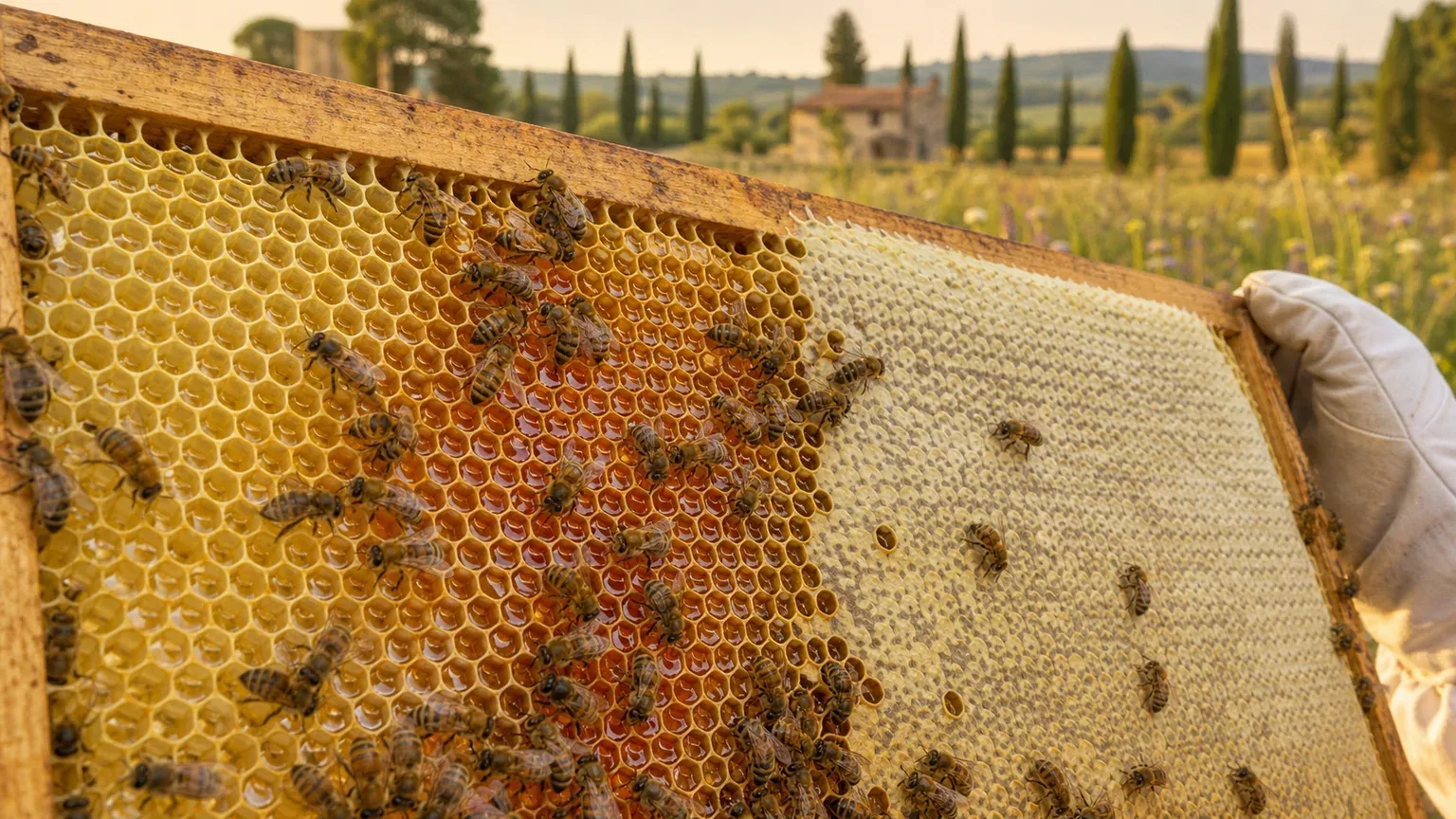
Bees may redistribute stores within the nest. A photograph of one frame captures a moment in a dynamic process, not a permanent assembly line with nectar always on one side and finished honey on the other.
Step 7: bees cap mature stores with wax
When stored honey is sufficiently ripened, workers seal the cell with a wax capping. The cap protects the food store from moisture and contamination while allowing it to remain available to the colony later. Capped honey often appears pale or white because of the wax surface, even when the liquid underneath is dark amber.
Beekeepers frequently use capping as a practical sign of readiness, but not every capped cell has exactly the same moisture and not every uncapped cell is necessarily unripe. Frame pattern, recent weather, nectar flow and an instrument reading may all inform the decision.
A refractometer estimates water content from the way light bends through a honey sample. Responsible producers use an appropriate, calibrated instrument and follow relevant local standards rather than relying on folk tests such as whether honey forms a thread or dissolves in water.
Why moisture matters
Honey's stability depends in part on its high sugar concentration and low available water. If water content is too high, osmotolerant yeasts may ferment the honey, producing gas, off aromas and other changes. Moisture risk is why premature harvest, humid storage and poorly sealed containers matter.
The Codex Standard generally sets a maximum moisture content of 20 percent for honey, with specified exceptions for certain products. Legal and buyer specifications can be stricter or more detailed. A beekeeper should follow the rules applicable to the honey's origin and destination.
Lower is not automatically better without limit. Honey is a natural food with origin-specific texture and handling needs. Quality is a combination of authenticity, appropriate maturity, cleanliness, sensory character and traceability—not a competition for one extreme number.
From capped frame to extracted honey
In a movable-frame hive, the beekeeper identifies suitable surplus frames and removes bees using methods chosen to minimize stress and contamination. Harvest equipment and the honey-handling space should be clean, food-safe and protected from pests, smoke residue and excessive humidity.
Wax cappings are removed with a knife, fork or uncapping tool. An extractor then spins the frames so centrifugal force moves honey from the cells to the extractor wall, where it drains downward. The comb can be returned for bees to clean and reuse, reducing the colony's need to rebuild all of that wax.
Extracted honey is commonly strained to remove larger wax particles and allowed to settle so air bubbles and fine debris can rise. Straining is not the same as industrial ultrafiltration. Practices vary by producer, market and legal definition, so labels such as raw or unfiltered should be interpreted under the rules where the honey is sold.
- ●Assess colony stores and select only appropriate surplus frames.
- ●Confirm maturity using frame evidence and, when needed, a refractometer.
- ●Uncap broodless honey comb with clean food-safe equipment.
- ●Extract, strain and settle without unnecessary heat or contamination.
- ●Package with batch, producer and origin traceability.
Why honey tastes different from one harvest to another
The plants supplying nectar contribute volatile compounds, minerals, acids, pigments and a characteristic sugar balance. A predominantly acacia flow may yield a pale, delicate honey that often crystallizes slowly. Chestnut can be darker and more assertive. Wildflower honey reflects a changing mixture rather than one fixed recipe.
Weather changes the result even at the same apiary. Rain can interrupt flight or dilute nectar; heat and drought can shorten bloom; humidity influences ripening conditions. Colony strength and the timing of harvest add further variation. Honest honey provenance therefore includes place and season, not merely a picturesque label.
Crystallization happens after honey is made
Crystallization is the natural formation of glucose crystals in honey. It does not mean the honey has spoiled or that sugar was added. The rate depends heavily on the glucose-to-water balance, seed crystals, temperature and floral origin.
Some honeys remain fluid for a long time; others set rapidly or are deliberately controlled into a fine, spreadable texture. Gentle warming can liquefy crystallized honey, but repeated or excessive heat can change aroma and heat-sensitive quality indicators.
Seven common honey-making myths
Simple explanations help children and first-time readers, but some become misleading when repeated as literal fact. The most useful corrections preserve the wonder of the process while making each claim more precise.
- ●Myth: pollen turns into honey. Reality: nectar or honeydew is the main raw material; pollen is a separate food resource.
- ●Myth: honey comes from a bee's digestive stomach. Reality: nectar is transported in the specialized honey crop before colony processing.
- ●Myth: one bee makes a jar. Reality: foragers, receivers, processors, fanners and wax workers contribute across the colony.
- ●Myth: all bees make harvestable honey. Reality: substantial stores are characteristic of honey bee colonies; most bee species do not produce a human harvest.
- ●Myth: every capped cell has identical moisture. Reality: capping is valuable evidence, not a universal laboratory measurement.
- ●Myth: crystallized honey is fake. Reality: crystallization is normal and strongly influenced by floral origin.
- ●Myth: dark honey is always healthier or better. Reality: color reflects origin and chemistry but does not create a universal quality ranking.
Honey is a record of colony, weather and place
A finished jar compresses thousands of flower visits, changing weather and coordinated colony work into one food. That makes traceability more valuable than romantic certainty. The producer should be able to identify the beekeeper, apiary region, harvest or batch and any meaningful floral-origin claim.
At BeePatron's Tuscan apiary, honey remains subject to real flowering and harvest conditions. Patronage does not command nature to produce a standardized output. The private seasonal story exists precisely because the route from nectar to jar changes with the living apiary.
Sources and further reading
Primary and institutional references used to review the factual claims in this guide. Product details and prices are BeePatron information.
- Honey definition and production : Food and Agriculture Organization of the United Nations
- Value-added products from beekeeping: Codex Standard for Honey : Food and Agriculture Organization of the United Nations
- Honey: floral nectar, dehydration and enzymatic ripening : USDA Agricultural Research Service
- The Complex Life of the Honey Bee : Purdue University Extension
- Good beekeeping practices for sustainable apiculture : Food and Agriculture Organization of the United Nations
Frequently asked questions
How do bees turn nectar into honey?
Workers collect nectar in the honey crop, add enzymes during handling, transfer and spread it inside the colony, remove much of its water through active exposure and nest airflow, then store and cap sufficiently ripened honey in wax comb.
Is honey bee vomit?
That phrase is an oversimplification. Nectar is carried in a specialized foregut storage organ called the honey crop, then transferred, enzymatically changed, dehydrated and stored by many workers. It is not ordinary digested stomach content.
Does pollen turn into honey?
No. Honey is made mainly from nectar or honeydew. Pollen is a separate protein-rich resource that honey bees collect and store, often as bee bread.
Why do bees cap honey?
Wax cappings protect sufficiently ripened stores from moisture and contamination until the colony needs them.
How long does it take bees to make honey?
There is no universal time. Nectar concentration, humidity, temperature, colony strength, airflow and storage space all influence ripening speed.
Do all bees make honey?
No. Honey bees are known for substantial colony stores. Bumblebees may keep small amounts for short-term colony use, while most solitary bees provision individual brood cells rather than producing harvestable honey.
How does a beekeeper know honey is ready?
Capped comb is an important clue, but beekeepers also consider the frame pattern, recent conditions and, when necessary, water content measured with a suitable refractometer.
Why is some honey light and some dark?
Floral or honeydew origin contributes different pigments, minerals, acids, aromas and sugar profiles. Weather, location, harvest and handling also affect the final jar.
Follow the Journey From Tuscan Flowers to Honey
Choose a named hive, meet the professionally managed apiary and follow a real season whose harvest remains shaped by nature.
Compare adoption plansContinue exploring
A Year in the Life of a Beehive
Place honey production inside the colony's complete seasonal cycle.
Read nextWhy Honey Crystallizes
Understand what happens to honey's sugars after harvest.
Read nextTuscan Honey Varieties
Compare the flowers and landscapes behind different Tuscan honeys.
Read nextHoney Bee vs Bumblebee vs Solitary Bee
Learn why only some bees maintain substantial shared honey stores.
Read next