
Honey Bee Behavior
Why Do Honey Bees Swarm? What It Means and What to Do
Understand swarming as natural colony reproduction, recognize a temporary cluster, respond safely and learn why prevention is more complex than adding an empty box.
Quick answer
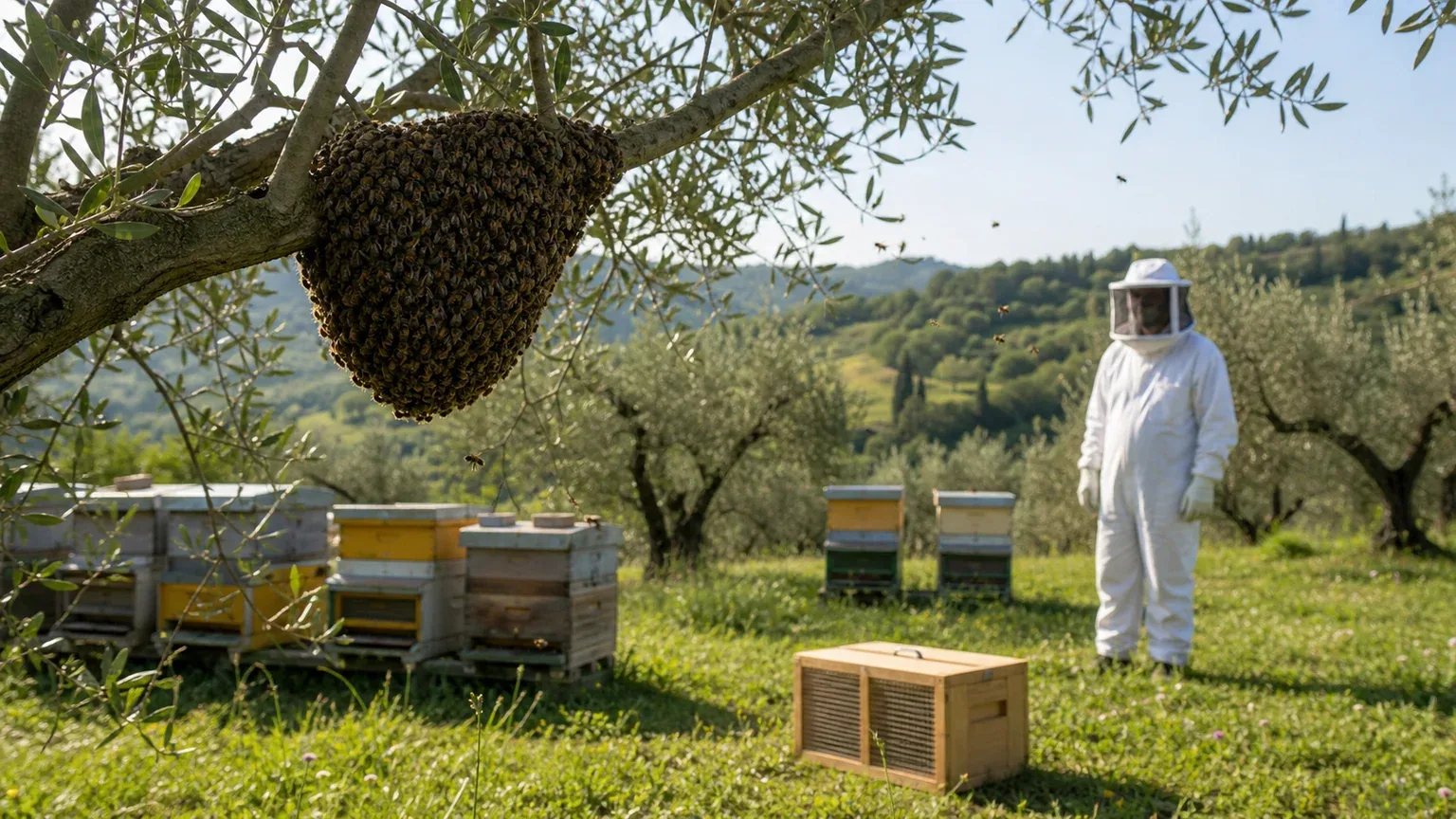
Honey bees swarm to reproduce at colony level. In a typical primary swarm, the established queen leaves with a large group of workers while the parent colony raises or retains a developing replacement queen. The swarm often forms a temporary cluster on a branch or structure while scouts evaluate nest sites. Clustered swarms are usually less defensive than bees protecting brood and stores, but they can sting. Keep people and pets back, do not spray or disturb the cluster, and contact a qualified local beekeeper or appropriate authority if removal is needed.
| Criterion | What you see | Best response |
|---|---|---|
| Flying swarm | Many bees moving together through the air during colony departure or relocation. | Go indoors or give it space; do not wave, spray or chase the bees. |
| Clustered swarm | A dense temporary ball or oval on a branch, fence or other surface. | Keep distance and contact a swarm collector if the location creates risk. |
| Established colony | Repeated traffic into a cavity, often continuing for days or longer. | Use an experienced live-removal specialist; sealing the entrance alone can worsen the problem. |
| Ground nest | Insects repeatedly entering soil, often not honey bees at all. | Identify the species before acting; bumblebees and solitary bees need different handling. |
Swarming is how one colony becomes two
Individual honey bees reproduce when queens lay eggs and drones mate, but a perennial colony also has its own reproductive event. During swarming, part of the workforce and a queen leave to establish another nest while the original site continues with brood, food and a replacement queen process.
This is why swarming can indicate a populous, successful colony rather than simple failure. For a beekeeper it still carries costs: the departing workforce reduces immediate foraging strength, the parent colony experiences a brood break and the swarm may settle where it creates conflict.
A swarm is not the same as migration or absconding. In absconding, nearly the entire colony abandons an unsuitable nest because of severe disturbance, resource failure, pests or other pressure. Swarming deliberately divides a colony that may otherwise be thriving.
Why a colony prepares to swarm
Swarm preparation commonly rises as population and brood production expand, particularly around strong spring forage in temperate regions. Congestion in the brood area, reduced open comb for the queen, worker age structure and changing distribution of queen pheromone are among interacting factors.
It is too simple to say bees swarm only because the box is physically full. A colony can prepare to swarm even when an additional empty super sits above it, especially if the brood nest remains congested or swarm momentum is already established. Genetics, queen age, weather and nectar flow also affect tendency.
Queen cells reveal preparation, not always outcome
Workers build elongated queen cells and provision selected female larvae. In swarm preparation, cells are often found along lower or outer comb areas, but position alone is not a perfect diagnosis. Colonies also raise queens for supersedure or emergency replacement.
Small empty queen cups are common and do not prove a swarm is imminent. Eggs or larvae in developed cells, colony congestion, queen condition and recent inspection history provide more useful context. Destroying every queen cell without correcting the cause can leave the colony queenless or merely delay departure.
The established queen usually leaves with the first swarm
Before departure, the laying queen becomes able to fly again as egg laying and worker feeding change. Workers fill their honey crops, and a large group pours from the entrance with the queen among them. They may fly only a short distance before settling into a cluster.
The parent colony retains comb, food, brood and developing queen cells. After a virgin queen emerges and later mates successfully, egg laying can resume. Some colonies issue smaller afterswarms with virgin queens, further reducing the original population.
Why thousands of bees hang in one temporary cluster
Workers gather around the queen, forming a living cluster that protects her and regulates temperature. The bees are not building exposed comb in the ordinary temporary stage; they are waiting while scout bees search for a suitable cavity.
A cluster may remain for hours or several days depending on weather and nest-site discovery. It can change shape, tighten in cool conditions or loosen as temperature rises. A swarm that has remained and begun building comb requires different assessment from a newly arrived cluster.
Scout bees debate where the swarm should live
Scouts inspect cavities for qualities such as volume, entrance and protection, then return to perform dances advertising promising sites. Other scouts visit those locations and add support. Recruitment shifts as weaker options lose dancers and a preferred site gains sufficient agreement.
Before takeoff, piping and vibrational signals help prepare the cluster. The queen does not compare properties and announce a winner; the collective decision emerges from competing scout activity.
Are swarms dangerous?
Clustered swarms are often less defensive than an established colony because they have no fixed brood nest or honey stores to protect. Workers also carry food for the transition. Less defensive does not mean unable to sting, harmless to allergic individuals or safe to handle without training.
Weather, disturbance, genetics and how long the bees have occupied a site can change behavior. Maintain distance, keep children and animals away and avoid vibration, thrown objects, water or chemicals. Anyone with a known severe sting allergy should follow their medical action plan and avoid the area.
What to do when a swarm lands
If the cluster is safely away from people and animals, observation from a distance may be all that is required; many swarms leave once scouts agree on a home. In a garden, public walkway or building entrance, contact a local beekeeping association, extension service, municipality or qualified swarm collector.
Send a photograph from a safe distance, exact location, approximate height, arrival time and access information. Mention allergy, traffic or livestock risks. Not every beekeeper collects swarms, access may require specialist equipment and a fee may apply.
- ●Keep people, pets and machinery away.
- ●Do not spray water, insecticide, smoke or household mixtures.
- ●Do not shake the branch or attempt a social-media capture method.
- ●Photograph from a safe distance for identification.
- ●Contact a qualified local collector when intervention is appropriate.
A swarm on a branch is different from bees inside a wall
A temporary cluster is exposed and usually has no established comb. Repeated bee traffic into a wall, chimney, roof or tree cavity suggests the colony has moved in. Once comb and brood are present, simple swarm collection is no longer the correct service.
Do not seal an active entrance. Trapped bees may enter interior rooms, and comb, honey and dead brood left in a structure can attract pests or leak. Seek an experienced live-removal professional who can assess access, remove bees and comb where feasible, and coordinate proper building repair.
How beekeepers manage swarm risk
Beekeepers inspect during the relevant season, provide usable space before congestion becomes severe and monitor queen cells, brood-nest structure and colony strength. Adding space can help when correctly timed, but it is not a guaranteed reversal once preparations advance.
Management options include redistributing frames, making a controlled split, moving the queen and brood within a planned system, or using other locally appropriate manipulations. Each can fail when timing, queen status or equipment is misunderstood. New beekeepers should learn with an experienced mentor and use methods suited to local climate and bee stock.
Swarm prevention should not become repeated destructive disturbance. The goal is to balance natural colony biology, neighbor safety, apiary capacity and responsible husbandry.
What happens after a beekeeper collects a swarm
A collector places the cluster into suitable hive equipment, ideally with the queen and most workers together. The bees may remain, or they may depart if the box and location are unacceptable. A captured swarm is not automatically healthy, gentle or permanently established.
The beekeeper assesses queen status, provides appropriate comb or foundation, monitors food and screens for pests and disease under local practice. Origin is often unknown, so biosecurity matters. Capturing bees is the beginning of colony management, not the end.
Swarming belongs to the honest seasonal story of an apiary
A real hive is not a static production box. Population expands, queens age, forage changes and colonies sometimes attempt reproduction despite skilled management. An apiary update that mentions queen cells, a controlled split or a captured swarm is not automatically evidence of failure.
Responsible storytelling avoids promising that a named hive will never swarm or that every colony follows one schedule. BeePatron's seasonal experience is valuable because it follows living systems whose outcomes depend on weather, biology and professional judgment.
Sources and further reading
Primary and institutional references used to review the factual claims in this guide. Product details and prices are BeePatron information.
Frequently asked questions
Why do honey bees swarm?
Swarming is colony-level reproduction: a queen and many workers leave to establish a new nest while the parent colony continues with a replacement-queen process.
Are swarming bees aggressive?
A temporary cluster is often less defensive than an established nest, but bees can still sting. Keep distance and never disturb or handle a swarm without training.
How long will a swarm stay on a branch?
It may remain for hours or several days while scouts choose a cavity. Weather and nest-site availability affect timing.
Should I spray a bee swarm with water?
No. Keep people and pets away and contact a qualified local beekeeper or authority if the location requires intervention.
Does a swarm contain the queen?
A primary swarm usually includes the established queen. Smaller afterswarms may leave with virgin queens.
Will an empty hive attract a swarm?
A suitable empty cavity may interest scouts, but attraction is not guaranteed. Bait-hive placement and management should follow local laws, biosecurity and experienced guidance.
Follow a Real Colony Through the Changing Season
Choose a named Tuscan hive and see how professional beekeepers respond to growth, forage, queen events and harvest conditions.
Compare adoption plansContinue exploring
How Honey Bees Communicate
Understand how scouts recruit to possible nest sites.
Read nextWhat Does a Queen Bee Do?
Follow the established queen and her replacement through swarming.
Read nextA Year in the Life of a Beehive
See why swarm risk rises during colony expansion.
Read nextHow to Help Bees Without Becoming a Beekeeper
Support bees responsibly without attempting an untrained capture.
Read next