
Honey Comparison
Acacia Honey vs Regular Honey: What’s the Difference?
Compare acacia and regular honey for taste, texture, tea and cooking. Learn what the labels mean and when a mild, slow-crystallizing honey suits you.
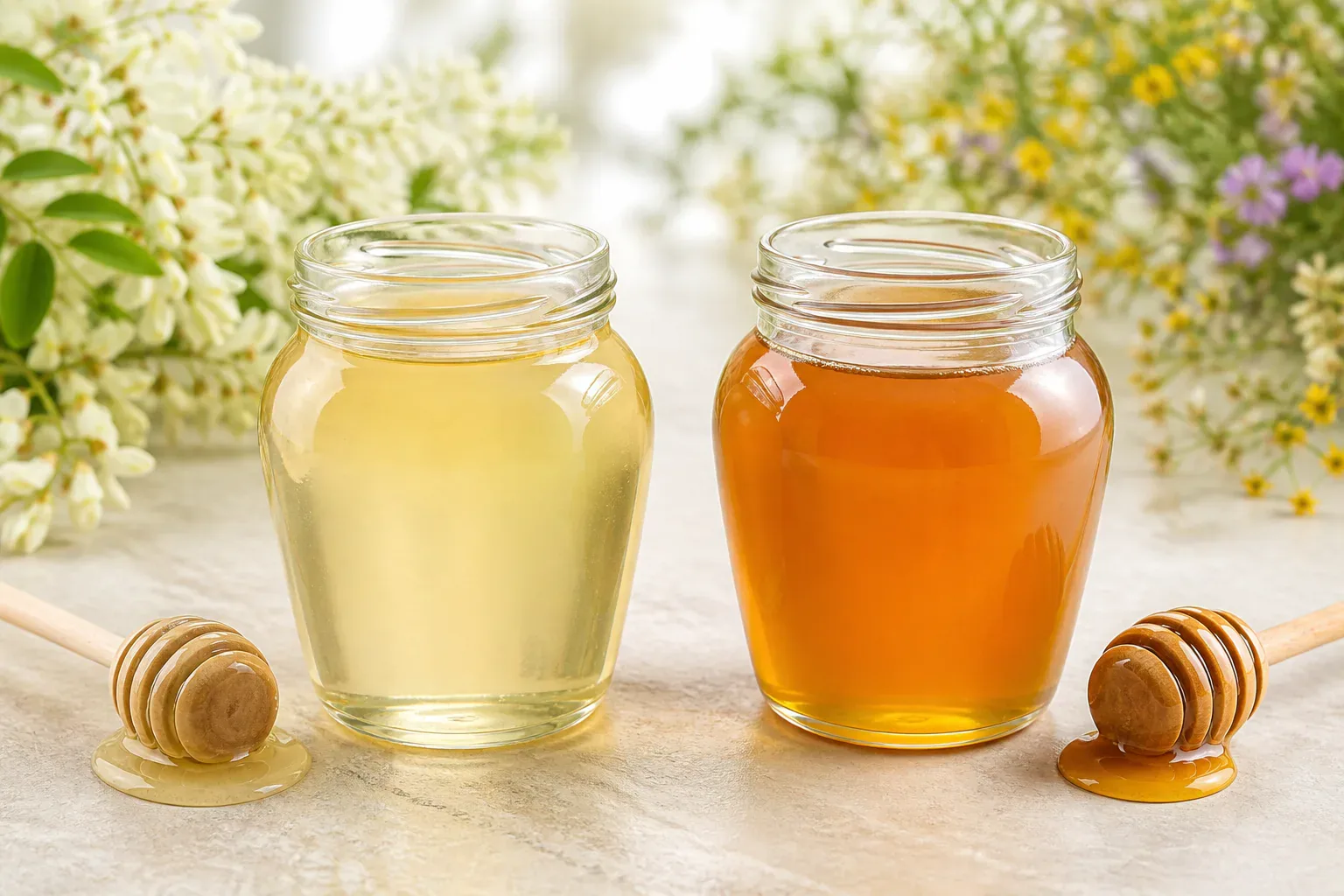
Quick answer
Acacia honey is honey whose stated botanical origin is black locust, Robinia pseudoacacia, and it is typically pale, mild and slower to crystallize because of its sugar profile. ‘Regular honey’ is not a formal botanical category. It may mean wildflower honey, blended honey, supermarket honey or simply the jar a buyer usually purchases. Compare the actual label, origin, producer, floral claim and batch—not the word regular. Acacia is not inherently purer or healthier than another compliant honey.
| Criterion | Acacia honey | ‘Regular’ honey |
|---|---|---|
| Meaning | A botanical-origin claim associated with black locust flowers. | An informal term with no single legal floral definition. |
| Typical taste | Delicate, clean and gently floral. | Can range from mild to dark, herbal, fruity or bitter. |
| Typical color | Very pale straw to light gold. | Any natural honey color depending on source and batch. |
| Crystallization | Often remains liquid longer than many floral honeys. | Depends on floral source, sugar balance, temperature and storage. |
Looking for an educational gift rooted in the real world?
Explore BeePatron’s named Tuscan hives and discover the meaning behind each one.
Explore the Hives‘Regular honey’ is not one type of honey
Consumers often use regular to mean inexpensive supermarket honey, ordinary wildflower honey or any product that is not marketed as monofloral. Those are different ideas. A retail shelf can contain single-origin, multi-origin, monofloral, multifloral, filtered, crystallized and blended products, all legally sold as honey when requirements are met.
Before comparing, replace regular with what the second jar actually says. Is it wildflower? A blend of EU and non-EU origins? A named regional honey? Without that information, the comparison can describe acacia but cannot responsibly characterize the other product.
What acacia honey actually means
European acacia honey is associated with black locust, Robinia pseudoacacia, despite the common name acacia. A monofloral claim indicates that the honey comes wholly or mainly from the stated source and has the corresponding characteristics under applicable rules and practice.
The name does not identify geography by itself. Acacia honey can be produced in more than one country or region. Tuscan acacia honey adds a geographical claim, while Miele della Lunigiana DOP is a specific protected designation with its own defined area and specification. These labels should not be treated as interchangeable.
Taste and color: delicate versus undefined
Acacia honey is commonly described as pale, sweet, clean and delicately floral, which makes it less likely to dominate tea, yogurt or mild cheese. These are typical sensory tendencies, not guarantees that every harvest tastes identical.
A jar called regular by the buyer might be wildflower honey with a fuller seasonal aroma, chestnut honey with darker and gently bitter notes or a mild blend designed for consistency. Darker does not mean more authentic, and paler does not mean more refined. Botanical source is the main reason profiles differ.
Why acacia honey often stays liquid longer
Acacia honey commonly has a sugar balance that favors slower crystallization, particularly a relatively high proportion of fructose compared with glucose. That is why a well-stored jar may remain clear and fluid longer than many other honeys.
Liquid texture is not proof of purity, and crystallization is not proof that another honey is fake. Storage temperature, moisture and seed crystals also affect timing. A genuine acacia honey can eventually crystallize, while another authentic honey may remain liquid for an extended period.
Which honey is better for tea, cooking and cheese?
Choose acacia when you want sweetness with minimal flavor interference. It can suit tea, fresh cheese, fruit, yogurt and recipes where a pale liquid honey is convenient. Its slow crystallization can also make it easy to drizzle.
Choose a more aromatic wildflower or assertive chestnut honey when the honey should contribute character. Baking and cooking expose honey to heat, so using the rarest jar is not always necessary. The better choice is the flavor and texture that fit the dish, not a universal quality hierarchy.
Is acacia honey worth paying more for?
Start with how you will use it. If a delicate flavor and a pourable texture matter for your breakfast, tea or fresh cheese, acacia may suit your preferences. If you enjoy the flavor of your usual honey or mainly use it in strongly flavored recipes, there is no need to change simply for the acacia name.
Compare prices per 100 grams or per ounce, using the same unit for both jars. Then compare the stated origin and producer information. A larger jar can cost more at checkout while costing less per serving; an expensive floral label alone does not tell you whether you will enjoy it more.
How to compare two jars at the store
Read the legal name, botanical description, country-of-origin statement, producer or packer and net quantity. Compare like with like: origin detail, floral claim, jar size and traceability. Marketing words such as premium, pure and natural do not replace those facts.
Reject kitchen purity tests based on flame, water, thumb patterns or crystallization speed. When authenticity matters, documented supply chains and validated analysis are more reliable than visual tricks. A transparent producer should explain what the label establishes and what natural variation remains.
- ●Identify the actual floral description on both jars.
- ●Read the stated country or countries of origin.
- ●Find the responsible producer or packer.
- ●Expect harvest-to-harvest sensory variation.
- ●Do not infer health superiority from color or liquidity.
Sources and further reading
Primary and institutional references used to review the factual claims in this guide. Product details and prices are BeePatron information.
Frequently asked questions
Is acacia honey better than regular honey?
Not inherently. Acacia is typically pale, mild and slow to crystallize. Another honey may be better when a stronger flavor or different origin is preferred.
Is acacia honey purer than other honey?
No. Acacia describes botanical origin, not a higher purity class. Quality and authenticity depend on the actual product, handling and traceability.
Why is acacia honey so clear?
Its floral source commonly produces a pale honey, and its sugar profile often keeps it liquid longer. Color and clarity still vary by batch and storage.
Does acacia honey taste different?
It is usually delicate, clean and gently floral compared with more aromatic wildflower or assertive chestnut honey, although every batch can vary.
Follow the floral story behind a Tuscan harvest
Compare current named-hive plans and their plan-specific honey inclusions.
Choose a Hive Give BeePatron as a Gift