
Honey Comparison
Acacia vs Wildflower Honey: Taste, Color & Best Uses
Compare acacia and wildflower honey by taste, color, crystallization, floral origin and best uses—and choose the right honey for your table or gift.
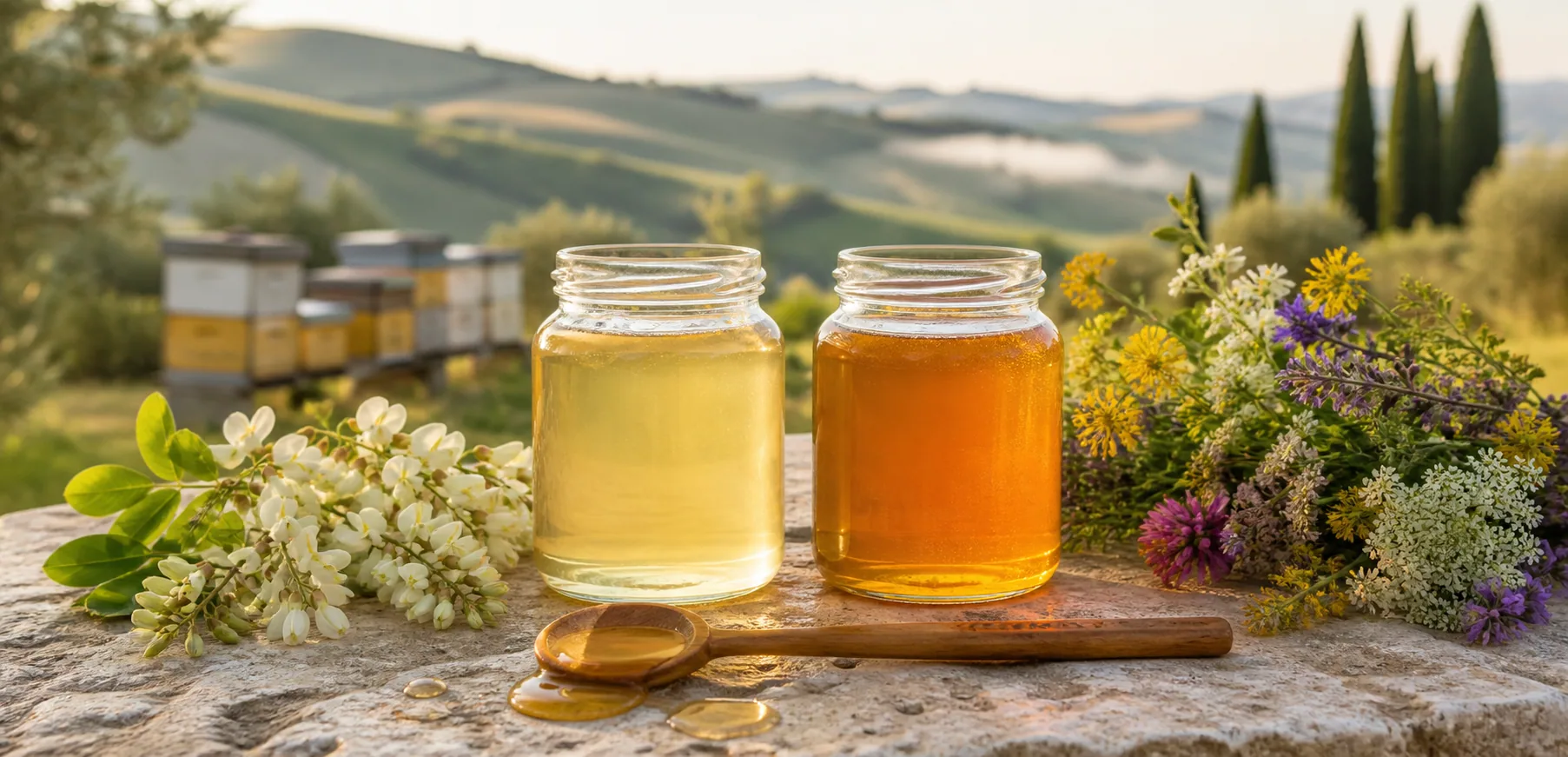
Quick answer
Choose acacia honey when you prefer a generally pale, delicate and slower-crystallising honey. Choose wildflower honey when you value a fuller expression of place and season, with greater variation in color, aroma and texture. Neither is inherently purer, healthier or higher quality. Origin, handling and traceable batch information matter more than the category alone.
| Criterion | Acacia honey | Wildflower honey |
|---|---|---|
| Floral origin | One predominant floral source. | Several flowering sources in a place and season. |
| Typical taste | Delicate, clean and sweet. | Variable, often more aromatic and layered. |
| Typical color | Very pale to straw-colored. | Ranges from pale gold to dark amber. |
| Crystallization | Usually remains liquid longer. | Speed and texture depend on the floral mix. |
| Best uses | Tea, yogurt, fruit and delicate cheeses. | Toast, aged cheese, marinades and tasting boards. |
Acacia vs wildflower honey at a glance
Acacia and wildflower honey describe two different relationships with flowering plants. Acacia is a monofloral name: the honey must come wholly or mainly from the indicated source and possess its corresponding characteristics. Wildflower, or millefiori, is multifloral honey shaped by several nectar sources.
That botanical distinction explains much of the practical difference. Acacia tends toward a restrained, consistent sensory profile and often remains fluid longer. Wildflower honey has a wider possible range because its floral mixture changes with location, harvest period and weather.
- ●Floral origin: one predominant source for acacia; multiple sources for wildflower.
- ●Typical color: very pale to straw for acacia; highly variable for wildflower.
- ●Typical flavor: delicate and clean for acacia; variable and often more layered for wildflower.
- ●Crystallization: commonly slower for acacia; batch-dependent for wildflower.
- ●Best reason to choose: subtlety for acacia; seasonal character for wildflower.
Monofloral does not mean that bees visited only one flower
Bees forage freely. Calling a honey acacia does not mean every drop of nectar came from one tree or that a beekeeper confined bees to a single plant. Under EU rules, the floral-origin claim is appropriate when the honey comes wholly or mainly from that source and possesses the expected sensory, physicochemical and microscopic characteristics.
Wildflower honey does not need one predominant source. It represents overlapping flowers available to the colony during the relevant period. It is not inferior because it lacks a single floral name, and it should not be treated as leftover or mixed-down honey.
Both categories can be traceable products of a defined place. The difference is whether one botanical source sufficiently defines the batch.
Taste: delicate familiarity or seasonal variation
Acacia honey is generally chosen for a pale appearance, pronounced sweetness and light aroma. Its restrained character works well when the honey should support rather than dominate another flavor. Official Tuscan descriptions of protected Lunigiana acacia honey refer to a delicate profile, but that protected specification should not be projected onto every acacia batch.
Wildflower honey can be mild, floral, herbal, warm, fruity or gently bitter depending on the contributing plants and harvest. Two jars from different Tuscan landscapes—or different periods in the same landscape—may have noticeably different personalities.
If predictability matters, acacia is often the easier choice. If discovery and connection to a particular season matter, wildflower may be more interesting. Neither preference is more sophisticated.
Texture: why acacia usually stays liquid longer
Acacia honey's natural sugar balance commonly slows crystallization. It is therefore often sold with a clear, pourable appearance and can retain that texture longer than many other honeys. It can still become cloudy or crystallize with time.
Wildflower honey has no single crystallization schedule because its botanical mixture changes. Some batches set relatively quickly; others remain fluid. Fine or coarse crystals reflect the crystallization process, not a simple purity ranking.
Storage also matters. Cooler temperatures can encourage crystallization, while excessive heat can diminish aroma and heat-sensitive characteristics. Texture should be appreciated or adjusted gently, never used as a standalone authenticity test.
Which honey works better for tea, breakfast and cheese?
For tea, yogurt, fruit or delicate fresh cheese, acacia is useful when you want sweetness with minimal flavor competition. Its fluid texture also makes it easy to drizzle. A mild wildflower batch can perform similarly, so the jar itself matters more than the name.
A more aromatic wildflower honey may be the better partner for toasted bread, aged cheese, marinades or a tasting board where the honey's own character should remain noticeable. There is no culinary rule preventing either honey from serving either purpose.
For gifting, acacia can feel polished and approachable. Wildflower can carry a stronger seasonal story. A thoughtful gift describes why the particular honey and origin were chosen rather than presenting one style as universally superior.
Try a simple side-by-side honey tasting
Taste a small amount of each honey on separate clean spoons before pairing it with food. Note the aroma, sweetness, texture and flavor that remains afterward. Then try both with the same plain yogurt or bread so the pairing is a fair comparison.
Keep the jar labels beside you and record the producer and harvest or batch details when available. Your result tells you which of these two jars you prefer; a different wildflower harvest may give a different result next time. For a gift, include a short card explaining your favorite pairing.
Which is healthier, purer or better quality?
The floral category alone cannot answer those questions. Honey is fundamentally a sugar-rich food, and broad health superiority claims should not be inferred from color or botanical name. Darker does not automatically mean better, and permanent liquidity does not prove purity.
Quality assessment depends on whether the product meets legal composition criteria, has been handled appropriately and matches its origin claims. Specialist analysis—not a flame, water, thumb or crystallization test—is the appropriate route when authenticity must be established.
A traceable wildflower honey can be more credible than a vaguely sourced acacia honey, and the reverse can also be true. Read the origin, producer or packer and lot information before paying for a romantic description.
How to choose between acacia and wildflower honey
Choose by the experience you want, then check whether the actual jar supports that expectation. For a mild, highly pourable everyday honey, begin with acacia. For a batch that expresses more of a landscape and season, begin with wildflower.
If you are comparing BeePatron plans, use the current plan description for the included variety and quantity. Honey remains an agricultural product connected to harvest conditions; the editorial comparison does not replace live package terms.
- ●Choose acacia for a generally delicate taste and slower crystallization.
- ●Choose wildflower for batch variation and a broader seasonal profile.
- ●Choose neither solely because of a claimed health or purity advantage.
- ●Check the origin, producer or packer and lot in both cases.
- ●Expect natural variation even within the same category.
Sources and further reading
Primary and institutional references used to review the factual claims in this guide. Product details and prices are BeePatron information.
- Council Directive 2001/110/EC relating to honey : EUR-Lex
- Honey: quality, labelling and the EU apiculture sector : European Commission
- PDO Honey from Lunigiana : Visit Tuscany — Regione Toscana
- Miele millefiori toscano : Regione Toscana
- Honey, biodiversity and the many forms of Italian wildflower honey : CREA — Council for Agricultural Research and Economics
Frequently asked questions
Is acacia honey better than wildflower honey?
Not inherently. Acacia is generally milder and slower to crystallize; wildflower offers more seasonal variation. Quality depends on the actual product, traceability and handling.
Which honey stays liquid longer?
Acacia honey usually remains liquid longer because of its typical natural sugar balance. Wildflower crystallization varies with the floral mixture and storage.
Which honey has a stronger flavor?
Wildflower often has a more variable or pronounced profile, but some batches are mild. Acacia is generally delicate and clean-tasting.
Is wildflower honey less pure because it comes from many flowers?
No. Multifloral describes botanical origin, not purity. Bees naturally collect nectar from several available plants, producing a legitimate category of honey.
Which is better as a gift?
Acacia suits recipients who prefer a delicate, fluid honey. Wildflower suits recipients interested in seasonal variation and a stronger expression of place. Provenance and presentation matter in either case.
Choose the Honey Story That Fits
Compare current BeePatron plans and follow an apiary experience grounded in Tuscany's changing seasons.
Compare adoption plans