
Bee Identification Guide
Honey Bee vs Bumblebee vs Solitary Bee: What Is the Difference?
Compare the bees most often seen in gardens by appearance, colony life, nesting, honey, pollination, stinging and the support each one needs.
Quick answer
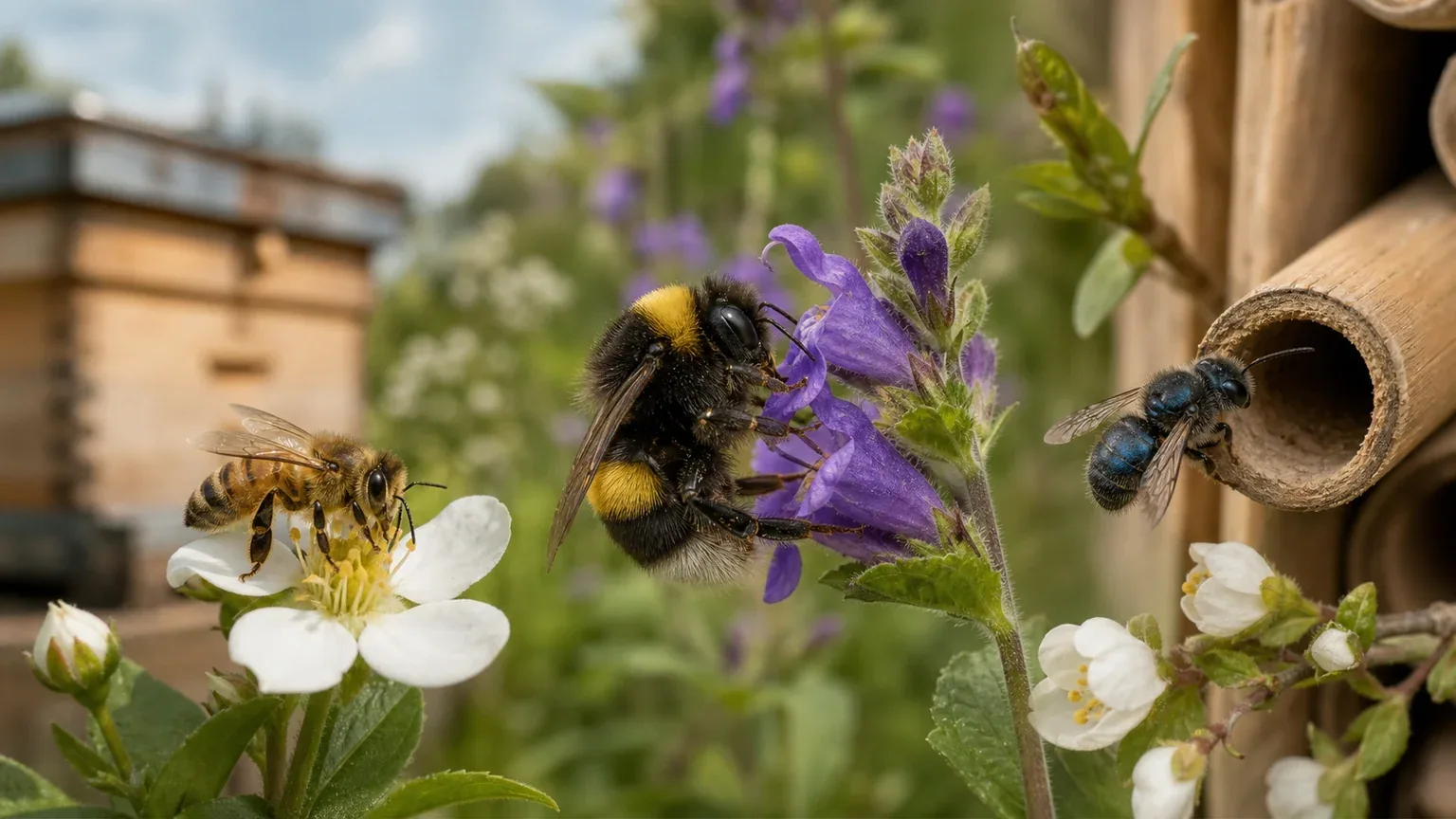
A honey bee is a slender, social bee that lives in a large perennial colony, stores substantial honey and may be managed by a beekeeper. A bumblebee is generally larger and furrier; most species form smaller annual colonies in which newly produced queens survive the winter. ‘Solitary bee’ describes many species whose females usually build and provision their own nests rather than living in a worker colony. Solitary bees vary greatly in size, color and nesting behavior, and most do not make honey for human harvest.
| Criterion | Typical pattern | Important exception |
|---|---|---|
| Social structure | Honey bees: large perennial colonies. Bumblebees: usually smaller annual colonies. Solitary bees: each female generally provisions her own nest. | Bee social behavior exists on a spectrum; some solitary species nest communally or show limited sociality. |
| Nest | Honey bees use wax comb in cavities or managed hives. Bumblebees often use sheltered cavities. Solitary bees use soil, stems, wood holes or other species-specific sites. | Nesting choices vary by species and region; appearance alone cannot reliably reveal the nest. |
| Honey | Honey bee colonies store enough honey to survive periods without forage and may produce a managed surplus. | Bumblebees store small amounts for colony use; solitary bees provision brood cells rather than filling harvestable combs. |
| Pollination | All three groups can be valuable pollinators, depending on the plant, season and location. | No single bee is the best pollinator for every flower, crop or ecosystem. |
The three labels do not describe equal taxonomic groups
‘Honey bee’ refers to bees in the genus Apis; the western honey bee, Apis mellifera, is the species most familiar in European and North American beekeeping. ‘Bumblebee’ refers to the genus Bombus. ‘Solitary bee’ is not one branch of the bee family tree: it is a broad description for species in which individual females generally make and provision their own nests.
That means a mason bee, leafcutter bee, mining bee and carpenter bee may all be described as solitary while looking and behaving very differently. Bumblebees and honey bees are both social, but their colony sizes, seasonal cycles, nesting habits and food stores differ substantially.
How they look at a glance
A western honey bee is usually slimmer than a bumblebee, with a golden-brown to dark banded abdomen and a moderately hairy thorax. A bumblebee is generally more robust and densely furry, often with conspicuous bands of black, yellow, orange, white or red that vary by species.
Solitary bees resist one visual summary. Some mason bees are compact and metallic blue or blue-black. Mining bees may resemble small honey bees. Leafcutter bees often carry pollen on hairs beneath the abdomen rather than in the pollen baskets seen on the hind legs of honey bee and bumblebee workers.
Color and size alone are not enough for species identification. Sex, age, lighting, worn hairs and regional diversity can change the impression. Use a local identification guide and several features together rather than relying on one photograph.
- ●Honey bee: typically slender, brown or amber, with a less plush appearance.
- ●Bumblebee: typically larger, rounder and conspicuously furry.
- ●Solitary bee: highly variable—from tiny metallic bees to large carpenter bees.
Colony life: perennial, annual or independent
A healthy honey bee colony can persist across years. The queen, workers and drones occupy wax comb, and the colony stores honey to survive periods when forage is unavailable. Workers cooperate in brood care, nest regulation, defense and food collection. Beekeepers manage colonies rather than individual bees.
Most bumblebee colonies follow an annual cycle in temperate regions. A mated queen emerges from overwintering, finds a nest site and raises the first workers. The colony grows through the season and produces new queens and males; typically, only the newly mated queens survive to begin again the following year.
A solitary female usually creates a nest and provisions separate brood cells with pollen and nectar before laying eggs. She receives no help from a worker caste. Some species nest in aggregations or share an entrance, but each female still tends her own brood cells.
Where each kind of bee nests
Honey bees naturally use protected cavities and build vertical wax comb; managed colonies live in hive equipment designed for inspection and care. A visible cluster hanging from a branch may be a temporary swarm searching for a new cavity, not a permanent open-air nest.
Bumblebees commonly choose insulated cavities, including old rodent burrows, spaces beneath sheds, compost heaps or tussocky vegetation, depending on species. Their nests are much smaller than a strong honey bee colony and do not contain the familiar parallel sheets of honey bee comb.
Many solitary bees nest underground. Others use hollow stems, existing beetle holes, cracks or soft pith. Carpenter bees excavate wood; leafcutter bees line brood cells with cut leaf pieces; mason bees use mud-like material as partitions. The correct habitat therefore depends on which local species are present.
Which bees make honey?
Honey bees convert nectar into honey and store it in quantity because a large colony must bridge periods with little forage, including winter in temperate climates. Responsible harvest leaves or provides what the managed colony needs and accounts for weather, floral source, colony strength and local practice.
Bumblebees make and store small amounts of nectar-based food for their own short-term use, but their annual colonies do not build the large, harvestable reserves associated with honey bees. Solitary bees place nectar and pollen provisions in brood cells for developing offspring; they do not produce a shared surplus for extraction.
Which bee is the best pollinator?
There is no universal winner. Honey bee colonies can field large numbers of foragers and be moved for agricultural pollination. They communicate profitable forage locations and visit many plant species. That scale makes them economically important for numerous crops.
Bumblebees can forage in cooler or dimmer conditions than honey bees in some contexts, and many perform buzz pollination: they vibrate flowers to release pollen. This is valuable for plants such as tomatoes and blueberries whose pollen is held in specialized anthers.
Wild solitary bees include efficient specialists and generalists. Some carry dry pollen in ways that can make contact with flowers especially effective; others have close relationships with particular plants. Pollination success depends on matching bee behavior to flower biology, not ranking every bee on one scale.
Do honey bees, bumblebees and solitary bees sting?
Females of many bee species can sting, while males cannot. Honey bee workers may defend their colony and can sting when trapped or threatened. Bumblebee workers and queens can sting, particularly if a nest is disturbed, though foraging bumblebees are usually focused on flowers rather than people.
Many solitary bees are unlikely to sting and have little collective nest to defend. Some are too small for their sting to be significant to most people, but this should not become a reason to handle them. Give all bees space, wear shoes near ground nests and seek medical advice for known sting allergy.
A smooth, shiny abdomen and hovering interest in food may indicate a wasp rather than a bee, but visual rules have exceptions. If insects are nesting in a high-risk location, use a qualified local professional for identification before considering action.
Are honey bees native? The answer depends on place
The western honey bee is native to parts of Europe, Africa and western Asia and has been introduced widely elsewhere. It is therefore native in Tuscany but introduced in North America and Australia. ‘Native bee’ must always be completed by a location; a species cannot be classified globally without geographic context.
Bumblebees and solitary bees also have regional ranges. A bumblebee native to one continent may be introduced on another, and commercially moved pollinators can create ecological and disease concerns. Avoid purchasing or releasing bees as a conservation gesture without region-specific expert guidance.
Do managed honey bees compete with wild bees?
They can. A dense concentration of managed colonies creates high demand for nectar and pollen, and research has identified competition and pathogen-related concerns in some landscapes. Risk depends on hive density, forage availability, season, habitat and the wild-bee community; it should not be reduced to ‘honey bees are always harmful’ or ‘more hives always help.’
This is especially important in conservation areas or places supporting sensitive native pollinators. Land managers and beekeepers should use local evidence, appropriate stocking decisions and monitoring. In working agricultural landscapes, managed honey bees remain important livestock and pollination partners while habitat for wild insects deserves separate protection.
How to support each group responsibly
For wild bumblebees and solitary bees, prioritize locally appropriate flowers across the season, undisturbed nesting habitat and reduced pesticide exposure. Retain some bare soil, stems, dead wood or tussocky cover where safe and relevant to local species. Treat bee hotels as managed nesting structures, not maintenance-free decoration.
For managed honey bees, support skilled beekeepers through traceable honey, transparent apiary programs and realistic expectations about season and harvest. Do not start a hive solely because ‘bees need help’; beekeeping requires training, continuing health management, legal compliance and suitable forage.
- ●Wild bees: protect habitat, nesting opportunities and local plant relationships.
- ●Managed honey bees: support competent husbandry and transparent provenance.
- ●Both: reduce chemical exposure and increase diverse, season-long forage where appropriate.
A practical garden identification sequence
First, watch behavior without approaching a nest. Is the bee collecting pollen, entering the ground, carrying leaf pieces or visiting a wooden cavity? Second, note size, body shape, hair, color and where pollen is carried. Third, take several clear photographs from a respectful distance and record date, location and flower.
Use a regional field guide, natural-history museum, extension service or moderated citizen-science platform. Avoid identifying only from yellow-and-black color. Hoverflies can resemble bees, wasps are diverse, and many small native bees are overlooked precisely because they do not match the familiar honey bee silhouette.
Sources and further reading
Primary and institutional references used to review the factual claims in this guide. Product details and prices are BeePatron information.
- Bee Basics: An Introduction to Our Native Bees : USDA Forest Service and Pollinator Partnership
- Are honey bees native to North America? : U.S. Geological Survey
- The role of honey bees as pollinators in natural areas : U.S. Forest Service Research and Development
- Bees in your garden : Royal Horticultural Society
- Solitary bees : Royal Botanic Gardens, Kew
Frequently asked questions
What is the main difference between a honey bee and a bumblebee?
Honey bees usually live in large perennial colonies and store substantial honey. Bumblebees are generally larger and furrier and, in temperate regions, usually form smaller annual colonies survived through winter by newly mated queens.
Is a bumblebee a solitary bee?
No. Bumblebees are social bees in the genus Bombus. Their colonies are smaller and usually shorter-lived than honey bee colonies, but they still include a queen and workers.
Do solitary bees make honey?
Solitary females collect nectar and pollen to provision individual brood cells, but they do not maintain a large shared colony or produce harvestable honey stores like honey bees.
Are all solitary bees native?
No. Native status depends on both species and location. ‘Solitary’ describes social behavior, not geographic origin.
Which bees can buzz-pollinate tomatoes?
Bumblebees and some solitary bees can vibrate flowers to release pollen. Honey bees do not perform true buzz pollination.
Which kind of bee is most endangered?
Risk is assessed species by species and region by region. Managed honey bee colony losses are an agricultural and husbandry concern, while conservation assessments focus on the status of particular wild bee species and populations.
Discover the Managed Honey Bee Story Up Close
Choose a named hive in a professionally managed Tuscan apiary and follow its seasonal journey without becoming the beekeeper.
Compare adoption plansContinue exploring
How to Help Bees Without Becoming a Beekeeper
Turn the comparison into practical habitat and purchasing decisions.
Read nextWhat Is Beehive Adoption?
Learn what supporting a professionally managed honey bee hive actually means.
Read nextA Year in the Life of a Beehive
Follow the annual cycle of a managed honey bee colony.
Read nextBeekeeping Seasons in Tuscany
See how weather, forage and colony needs shape apiary work.
Read next