Honey at home
How to Host a Honey Tasting Party at Home
Plan a relaxed honey tasting party with three jars, a simple shopping list, a 45-minute hosting plan, and tasting prompts your guests can actually use.
Quick answer
For a first honey tasting party, choose three contrasting honeys and invite a small group. Taste tiny samples on their own, write a few impressions, then introduce bread or other pairings. Provide clean spoons, water and the original jar labels. The 45-minute plan below is our suggested hosting format, not a professional grading protocol.
Choose three jars with a reason to compare them
A good tasting begins with a question. Are you curious about honeys from different places, several floral sources, or two batches from one producer? Choose one theme so the evening has a point beyond opening a row of jars. You do not need rare bottles or a large budget to create an interesting comparison.
For a first gathering, we suggest three samples: one you already enjoy, one that sounds different, and one chosen by a guest. This gives everyone an easy starting point. Ask the seller about the honey's origin and the information available for that batch; avoid building the evening around claims the jar does not support.
Make the theme explicit on the invitation: ‘Three honeys, three first impressions, then toast.’ That sounds approachable and tells guests they do not need expertise. If you are bringing together people who do not know each other, the shared task gives them something concrete to discuss.
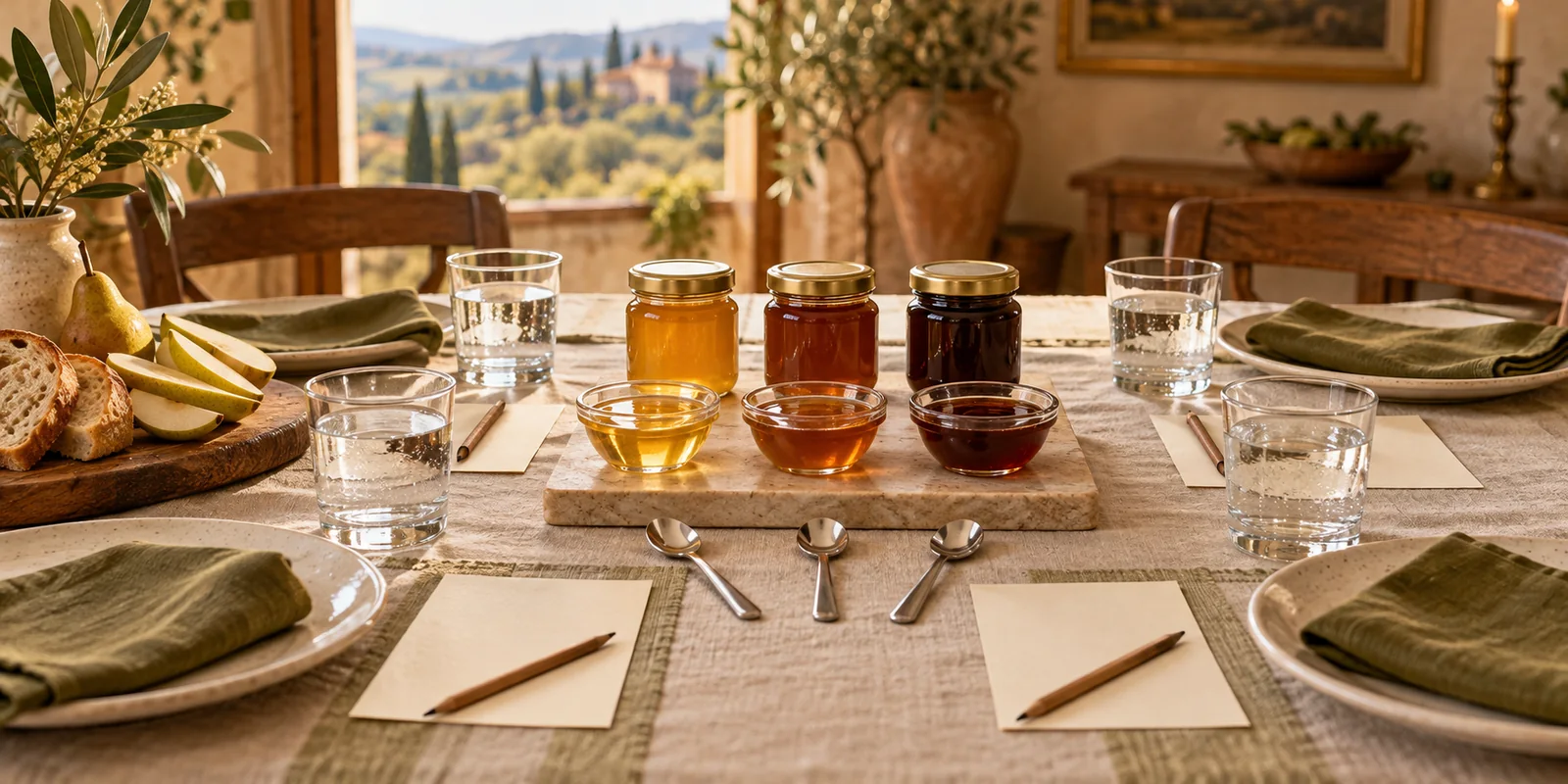
A practical setup for four guests
Use a table with enough room for everyone to put down a glass and a note card. The University of Arizona's tasting guidance recommends a setting without distracting odors, individual clean spoons, water between samples, and written observations. Those fundamentals matter more than matching bowls.
Our suggested setup is deliberately small. Set aside a little of each honey for tasting and keep the jars nearby for the reveal. Let people ask for another sample instead of starting with large portions. There is no need to finish a serving to have an opinion about it.
Check food preferences and allergies before planning the pairing round. Keep original labels available for every packaged food. If children join, adapt the activity to their age and supervision needs; the CDC advises against giving honey to children under 12 months.
- ●Three different honeys, each with its original label.
- ●Three small serving dishes and separate serving utensils.
- ●At least twelve clean tasting spoons, plus spares.
- ●Four water glasses, four note cards and four pencils.
- ●Plain bread or crackers, plus one optional pairing food.
- ●A tray or bowl for used spoons and somewhere to set the jars.
Use this flexible 45-minute party plan
Start with five minutes to explain the theme and show everyone the setup. Tell guests there is no answer key for personal preference. You can leave the labels visible for an educational tasting or hide the brand names until the end if you want to reduce the influence of packaging.
Give the first round about fifteen minutes. Work through the samples in the same order, allowing quiet time before anyone comments. University of Arizona Extension suggests beginning with lighter honeys and moving toward darker ones. Treat that as a convenient starting order rather than a claim that color determines quality.
Spend the next fifteen minutes discussing and pairing. Finish with a ten-minute reveal: show the jars, compare first impressions, and ask everyone which honey they would use again. If conversation is flowing, extend the evening. If the group is done, stop; the schedule serves the guests, not the other way around.
- ●0–5 minutes: introduce the theme and explain the tasting order.
- ●5–20 minutes: taste each honey on its own and record impressions.
- ●20–35 minutes: compare notes, then try a small pairing round.
- ●35–45 minutes: reveal labels and choose personal favorites.
Give guests prompts instead of expert vocabulary
An empty page can make a casual tasting feel like an exam. Divide each note card into four small spaces: first impression, texture, finish, and where I would use it. Let guests write a word, a sentence, or a drawing. The record is useful if it helps them remember a preference later.
Arizona's guidance encourages noticing appearance, aroma and the experience as you taste. Keep the conversation open: ‘What does this remind you of?’ usually works better than announcing a specific aroma before anyone has tried the sample. Familiar comparisons from a guest's own kitchen are welcome.
Ask everyone to write before the first person speaks. Otherwise, one confident description can become the entire table's answer. When you compare cards, look for both agreements and surprises. Two different descriptions can start a useful conversation without one guest having to be wrong.
Change one thing at a time in the pairing round
For your first pairing, put each honey on the same plain bread or cracker. This is our suggested home experiment: holding the food constant makes it easier to describe how the combinations differ. Use small portions so people can stop when they have tasted enough sweetness.
Then invite each guest to choose one combination to revisit. You might offer pear, a cheese your guests already like, or a plain yogurt served according to its storage instructions. Present these as starting ideas, not universal rules about which honey must accompany which food.
Keep strong flavors until after the plain-honey round. If the party is part of dinner, do the focused tasting before moving on to the meal. There is no need to turn an entire evening into a technical exercise; a short comparison can be the opening activity rather than the whole event.
Send guests home with a memory, not a sales pitch
Photograph the jar labels so everyone can identify a favorite. Let guests take their note cards, or send them a short list afterward if they ask. A simple invitation to bring a different jar next time makes the gathering easy to repeat.
You can also make the tasting a birthday activity or a quiet evening for two by reducing the setup. For a remote gathering, agree on the same jars in advance and allow enough time for each person to obtain them. Do not assume that similarly named honeys are identical batches.
If you are exploring BeePatron, use the tasting as a way to notice the food more closely. BeePatron's plans describe their own hive experience and honey inclusions; a home tasting party is an activity you organize yourself, not an included event or a guaranteed selection of varieties.
Sources and further reading
Primary and institutional references used to review the factual claims in this guide. Product details and prices are BeePatron information.
Frequently asked questions
How many honeys do I need for a tasting party?
Three is our suggested starting point for a small home gathering. It offers comparison without requiring a large collection. Two contrasting jars can also make an enjoyable shorter activity.
Does the darkest honey have to be the strongest?
Do not use color as a guaranteed flavor ranking. Starting light and ending dark is a convenient tasting order, but describe what you actually experience in each sample.
Should guests know the brands before tasting?
Either approach works. Visible labels support a discussion of provenance; hiding brand names until the reveal can help guests focus on their first impressions.
Can I host a honey tasting without cheese?
Yes. Taste the honey alone, then try plain bread or a pairing that suits your guests. Cheese is optional, and food preferences should shape the menu.
Continue the honey story beyond the table
Explore BeePatron's current plans for a connection to a real beehive and the honey inclusions described for each option.
Explore BeePatron plans