
Honey at home
How to Store Honey: A Practical Pantry Guide
Learn where to keep honey, how to care for an opened jar, and what to do when it crystallizes. Includes a simple pantry checklist for everyday use.
Quick answer
Keep plain honey tightly closed in a dry cupboard, away from direct sun and cooking heat. Use a clean, dry spoon and close the jar after serving. Refrigeration is usually unnecessary for everyday use. Crystals alone are a normal texture change, not a reason to discard honey. Follow the producer's instructions for products with added ingredients.
Choose a cupboard before choosing a container
The best honey storage routine begins with a place you can use consistently. Pick an accessible cupboard where the jar can stand upright, the lid stays easy to find, and you can read the label without unpacking a shelf. If you use honey at breakfast, a space beside the plates may be more practical than a decorative display across the kitchen.
University of Missouri Extension recommends a dry location at 50–70°F (about 10–21°C) and a tightly covered container. Sioux Honey's guidance emphasizes ordinary room temperature and avoiding direct heat. The useful household principle is a stable, shaded spot rather than a sunny windowsill or the shelf immediately above a stove.
Do a quick cupboard audit: take out the jar, check the lid, and decide where it belongs after breakfast. A beautiful jar left beside the kettle for weeks is easy to overlook. Make its everyday storage place more convenient than the temporary place where it tends to accumulate.
- ●Choose one regular home for the jar.
- ●Keep the producer's label readable.
- ●Leave enough clearance to lift the jar without tilting it.
- ●Store the serving spoon separately so it can be cleaned and dried.
Build a simple routine for an opened jar
Keep the original container if it closes properly. Sioux Honey notes that a tight seal helps prevent honey from taking up moisture and surrounding odors. If you transfer it, use a clean, completely dry container intended for food and retain the original label or a photograph of it.
Set out what you need before opening the honey: your bowl or plate, a clean spoon, and somewhere to rest it. Spoon a little honey into your serving dish rather than repeatedly moving between the shared jar and food. Wipe sticky residue from the outside, make sure the rim is dry, and replace the lid.
If several people share the kitchen, a short note is more useful than a complicated rule: ‘Dry spoon; close the lid; back in the cupboard.’ Put the note inside the cupboard door if you want the counter to stay clear. The goal is a repeatable habit, not a special ceremony every time someone makes toast.
Should honey go in the refrigerator?
For the plain honey you use regularly, a pantry is generally more convenient. University of Missouri Extension notes that refrigeration can encourage crystal formation, while Sioux Honey advises against it for everyday storage because the honey becomes harder to dispense. An opened jar of plain honey does not automatically need the same treatment as an opened dairy product.
Keep that advice separate from recipes and blended products. Honey butter, a sauce containing honey, or a commercial spread with additional ingredients is a different food. Read its own storage directions; the presence of honey does not turn everything mixed with it into a pantry product.
When a gift arrives, check what it actually contains before arranging it on the shelf. Keep the instructions with the jar. A ribbon and a handwritten tag can look lovely, but they should never replace the information supplied by the producer.
Treat crystallization as a texture question
Sioux Honey describes granulation as a natural characteristic that does not, by itself, indicate deterioration. Before doing anything, decide whether you need the honey to pour. You might prefer its thicker texture on toast or find it easier to portion with a spoon.
If you want it liquid, University of Missouri Extension describes gently warming honey in a suitable non-plastic container set in warm water. Keep water out of the honey. Avoid turning a small texture adjustment into an aggressive heating session; follow the producer's advice for the particular jar.
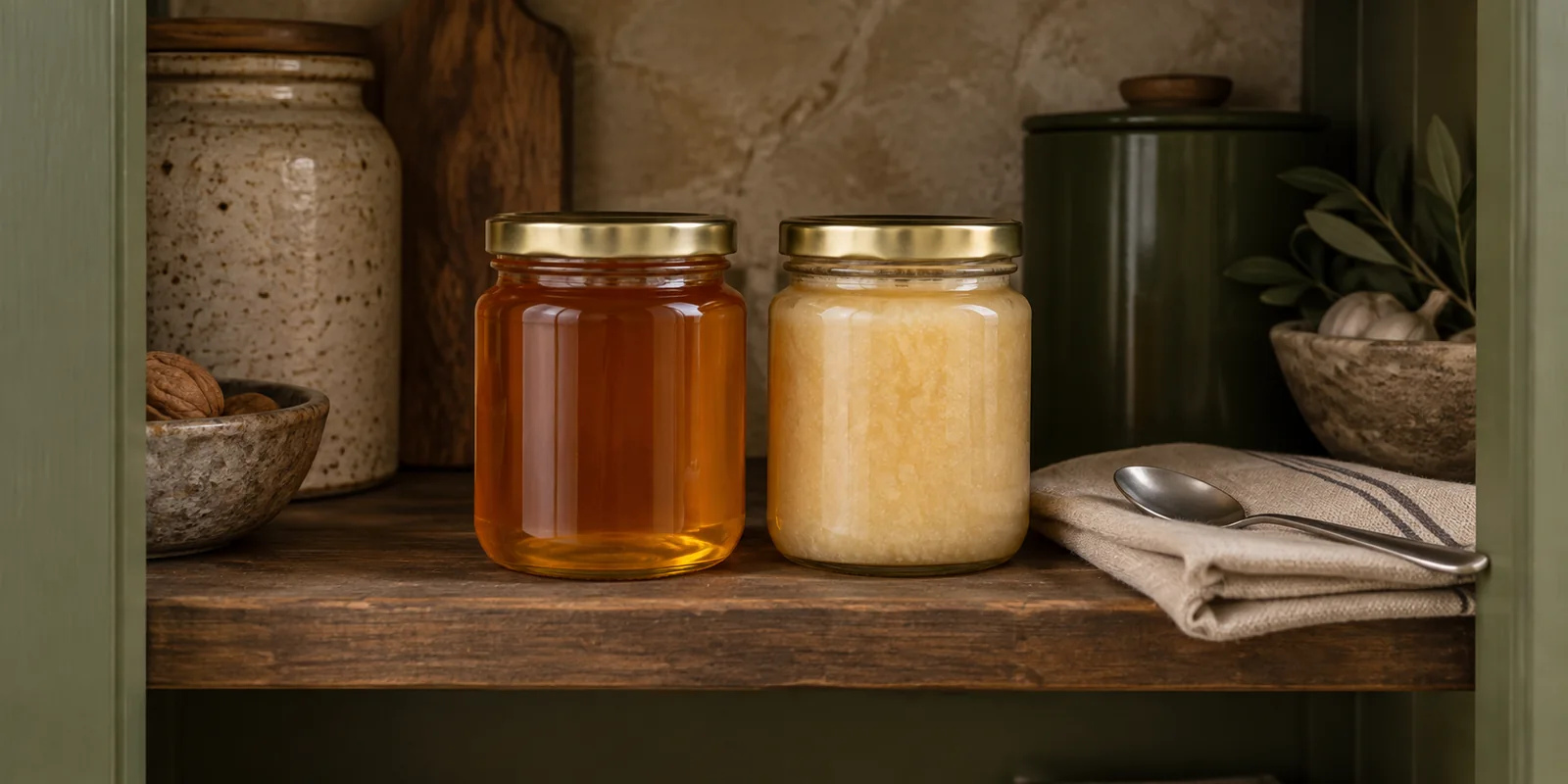
Two jars do not need to behave identically to belong in the same cupboard. Label them by their actual variety or batch, rather than ‘good’ and ‘bad’ based on whether they pour. Our crystallization guide explains the texture change in more detail, while the shelf-life guide addresses questions about older honey.
Organize a small honey collection by how you use it
If you have several honeys, assign a role to each rather than opening every jar at once. One can be the breakfast jar; another can be reserved for a side-by-side tasting. Put duplicates behind the open jar so you can see what you already own before buying more.
Write the opening date on a removable label if that helps you keep track. It is an organizational aid, not a homemade expiry date. Keep a brief note about what you liked: ‘best on plain yogurt’ or ‘save for tasting with friends’ is more useful than a complicated scoring system you will not revisit.
For a large household, choose a serving routine everyone can follow. For a person living alone, consider whether a smaller next purchase would be easier to enjoy. Buying an amount that fits your habits can be more useful than searching for a perfect way to store a collection you rarely use.
Add a useful care card when giving honey
A honey gift feels more considered when the recipient knows what to do with it. Include the producer's storage instructions, the name of the honey, and one serving idea. Leave the original packaging information intact and avoid promises such as ‘never changes’ or ‘always stays liquid.’
For a household with a baby, keep the message clear: the CDC advises that honey should not be given to children younger than 12 months. A honey gift for parents is a gift for the adults, not an infant food.
If the gift is connected to BeePatron, explain the chosen plan using its current description. A cupboard-care card can accompany the honey when it arrives; it should not imply a particular jar quantity, harvest date, or delivery schedule beyond the actual purchase terms.
Sources and further reading
Primary and institutional references used to review the factual claims in this guide. Product details and prices are BeePatron information.
Frequently asked questions
Can I keep honey in its original jar?
Yes, provided the container is suitable for food and its lid closes properly. Keeping the original jar also preserves the producer's identity and instructions.
Does opened honey need refrigeration?
Plain honey generally does not need refrigeration for everyday use. Products mixed with other ingredients may have different requirements; follow their labels.
Should I throw away honey that has crystallized?
Crystals alone are not a reason to discard it. Crystallization is a normal texture change. Questions about contamination or an older jar should be considered separately.
Can I use a decorative honey pot?
Choose one intended for food with a lid that closes properly. A pot designed mainly for table presentation may be less convenient for storage than the original sealed jar.
Explore the story behind the honey
Discover BeePatron's beehive adoption plans and check the current honey inclusions, experience details and delivery terms before choosing.
Explore BeePatron plans