
Honey Science
Why Is Some Honey Thicker Than Others?
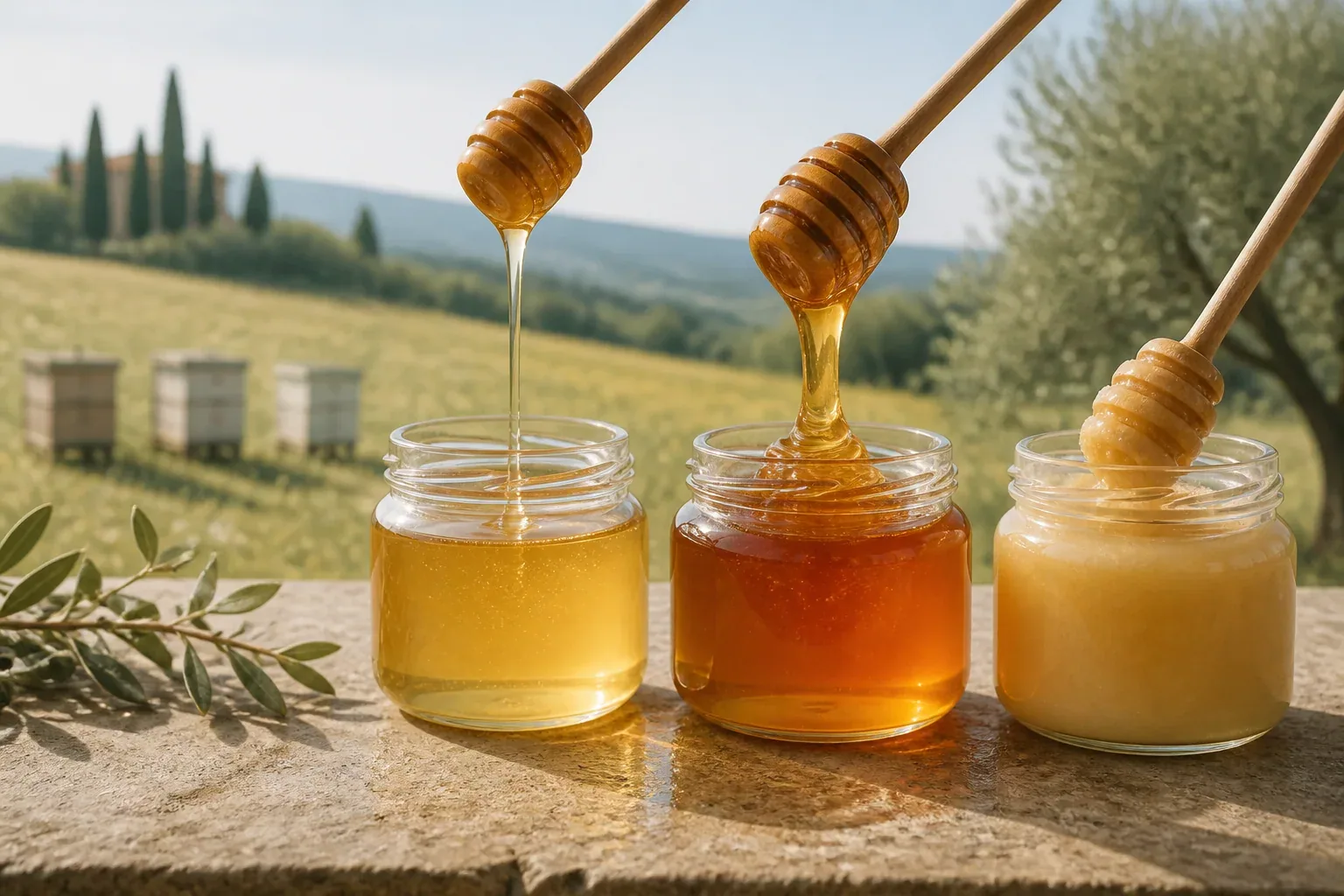
Honey thickness changes with temperature, water content, floral source and crystallization. Learn what texture can—and cannot—tell you about a jar.
Quick answer
Some honey is thicker because viscosity rises when temperature falls and generally rises as water content decreases. Botanical origin changes the mixture of sugars and other compounds, while crystallization can turn a pourable liquid into a creamy or firm mass. Processing and storage also matter. Thick honey is not automatically raw, pure or high quality, and thin honey is not automatically diluted. Evaluate the label, storage history, fermentation signs and traceability rather than relying on texture alone.
| Criterion | Effect on texture | What it does not prove |
|---|---|---|
| Cool temperature | Makes liquid honey flow more slowly. | That the honey is crystallized or unusually pure. |
| Lower water content | Generally increases viscosity. | Exact moisture without a suitable measurement. |
| Crystallization | Creates fine, creamy, coarse or firm textures. | That honey is fake, spoiled or necessarily raw. |
| Floral source | Changes sugar balance and crystallization tendency. | Geographic origin based on appearance alone. |
Looking for an educational gift rooted in the real world?
Explore BeePatron’s named Tuscan hives and discover the meaning behind each one.
Explore the HivesThickness is viscosity, not a purity score
Viscosity describes resistance to flow. Water pours easily because its viscosity is low; honey resists flow because it is a concentrated solution dominated by sugars. But honey is not one standardized liquid. Natural batches differ, and the same jar can pour differently in a warm kitchen and a cool pantry.
Online demonstrations sometimes treat a slow ribbon, unbroken strand or surface pattern as proof of authenticity. These observations are not validated purity tests. Temperature, moisture, crystals, container shape and handling can change the result without revealing adulteration or origin.
Temperature can change thickness within minutes
Liquid honey becomes less viscous as it warms and more viscous as it cools. That is why a jar may pour slowly on a winter morning and much faster after sitting in a warm room. The sugars have not necessarily changed; their movement through the liquid has become easier at the higher temperature.
Avoid using direct high heat simply to make honey run. If a gentler texture is wanted, warm the closed container gradually in warm water and follow the producer's storage guidance. Repeated or excessive heating can alter aroma, color and other quality characteristics.
Water content strongly influences flow
Ripe honey contains much less water than the nectar collected by bees. During ripening, workers spread nectar and support evaporation before storing mature honey. Within the normal range, a batch with less water will generally be more viscous at the same temperature than one with more water.
Appearance cannot provide an exact moisture reading. Beekeepers and honey handlers use appropriate instruments and methods when moisture matters. Excess moisture can increase fermentation risk, but a visibly runny jar is not by itself proof that water was added; warm temperature and botanical differences can also produce faster flow.
Floral source changes sugars and crystallization behavior
Different nectar sources lead to different proportions of fructose, glucose and other components. Honey with a greater tendency to crystallize may thicken sooner as glucose crystals form. Acacia-type honey often remains fluid longer, while other floral profiles can set more readily.
These are tendencies, not an infallible identification method. A batch's moisture, temperature, seed crystals, storage and blending history all influence what the consumer sees. Use the product label and traceability information to evaluate botanical and geographic claims.
Crystallization is different from liquid viscosity
A jar can feel thick because its liquid phase is viscous, because crystals have begun forming or because both are happening. Fine controlled crystals create creamed honey; larger crystals can produce a coarse texture; extensive crystallization can make honey appear almost solid.
Crystallization is normally a physical change, not spoilage. It does not establish that honey is raw or pure, and remaining liquid does not establish that it is fake. If a crystallized texture is inconvenient, gentle warming can dissolve crystals, though they may form again later.
When does texture suggest a real problem?
Texture alone rarely diagnoses spoilage. Look instead for a combination of warning signs such as active bubbling, pressure, foam, leakage or a clearly fermented odor. Natural air bubbles introduced during packing are not the same as ongoing gas production.
Check the container, best-before information and storage directions. If the seal is compromised, the jar behaves unusually or food safety is uncertain, contact the producer and do not rely on a social-media test. For ordinary thickening or crystallization without warning signs, the honey is often simply changing texture.
- ●Compare jars only at the same temperature.
- ●Read the floral and origin statements on the label.
- ●Expect texture to change during storage.
- ●Treat flame, water and thumb tests as unreliable.
- ●Ask the producer when fermentation or packaging integrity is a concern.
Sources and further reading
Primary and institutional references used to review the factual claims in this guide. Product details and prices are BeePatron information.
Frequently asked questions
Does thick honey mean it is pure?
No. Temperature, moisture, floral source and crystallization all affect thickness. Authenticity requires traceability and, when necessary, validated analysis.
Why is my honey runny?
It may be warm, naturally higher in moisture within an acceptable range, slow to crystallize because of its floral source or recently processed. Runny texture alone does not prove dilution.
Why did my honey become solid?
It most likely crystallized as glucose formed crystals. This is usually a normal texture change rather than spoilage.
Can I make thick honey runny again?
Crystallized honey can often be softened by warming the closed jar gradually in warm water. Avoid boiling or direct high heat and follow the producer's guidance.
Taste honey with its real origin in view
Explore a named-hive experience connected with a Tuscan apiary and plan-specific honey.
Choose a Hive Give BeePatron as a Gift